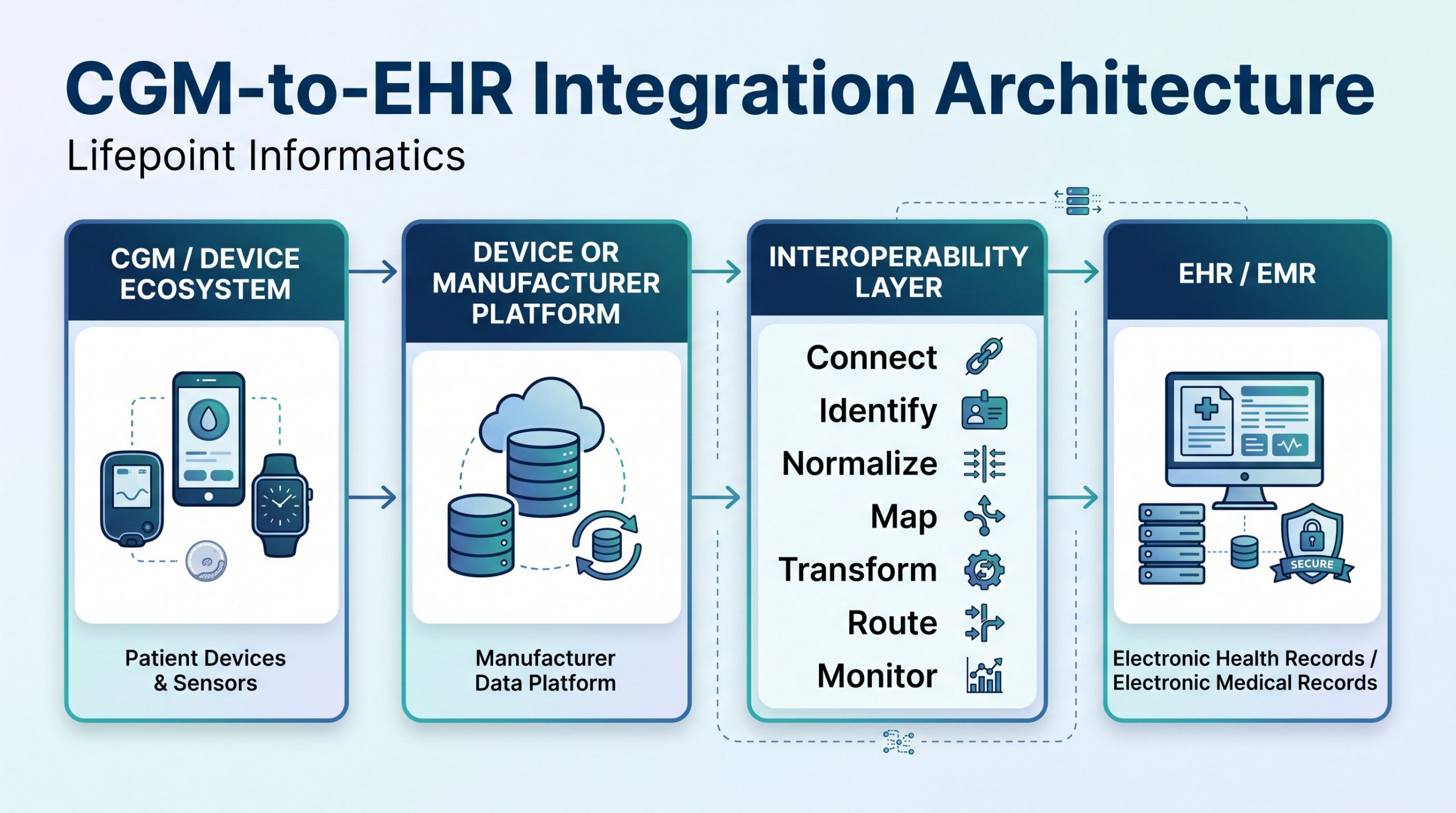
Getting CGM readings into an EHR is an interoperability problem, not a device connection problem. The sensor produces high-frequency, context-dependent data that a standard result-delivery architecture wasn’t built to handle. A working integration has to identify the patient, connect to the device ecosystem, normalize the data, map it to the receiving EHR, and deliver the level of detail the clinical workflow actually needs. Skip any of those stages and the problems show up after go-live, not before. Lifepoint Informatics covers the interoperability stack for patient monitoring and medical device integration across HL7, FHIR, and EHR environments. Confirm specific CGM manufacturer support, clinical calculations, and billing workflows with their Product and Engineering team before deployment.
Why CGM Integration Is Harder Than It Looks
Put a continuous glucose monitor in front of an IT team and tell them to get its readings into the EHR. Watch what happens. Nine times out of ten, the conversation starts with connectivity and ends with interoperability, because those are two different problems. Continuous glucose monitor device integration isn’t about plugging a device into a port. The sensor produces a data stream. The EHR expects structured, contextualized clinical information. Getting from one to the other reliably, at scale, across rotating care teams, is where most projects hit trouble.
This post covers how CGM data actually moves from device to record, what makes it structurally different from a standard lab result, where HL7 and FHIR fit into the picture, and what a health system needs to nail down before development starts.
What CGM-to-EHR Integration Actually Means
CGM EHR integration is the process of pulling supported continuous glucose monitor data out of a device or device platform and delivering it to an electronic health record in a form a clinician can use. The connection method varies. Depending on the manufacturer and the receiving EHR, it might go through manufacturer APIs, device gateways, interoperability middleware, HL7 messaging, FHIR APIs, or some combination.
The goal isn’t to fill every EHR screen with raw sensor readings. Patient identity, units, timestamps, and device context have to travel with the data. Miss any of those elements, and you’ve moved bytes without integrating anything.
Why CGM Data Is Not Just Another Clinical Result
A lab result is a discrete event. A clinician ordered a test, sample went to the instrument, result came back. One transaction, one record. CGM data has nothing in common with that model. A sensor continuously attached to the patient generates readings every few minutes across a monitoring period that spans days or weeks. That volume and continuity create design requirements a standard result-delivery architecture was never built to handle.
| Factor | Why it matters for integration |
|---|---|
| Data volume | A single CGM device produces far more data points per day than a standard lab order produces per week. The integration layer has to absorb that throughput without flooding the receiving EHR. |
| Context dependency | One reading at 2:47 a.m. means almost nothing without trend direction, time in range, or calibration status. Strip context during integration, and the data arrives but never gets used. |
| Source path | Readings don’t travel directly from sensor to integration layer. They pass through a smartphone app, a receiver, or a manufacturer cloud platform. The connection point is wherever the data surfaces. |
| Patient matching | A device-generated data stream does not know EHR patient identifiers. Matching logic has to be built and validated per implementation. Assuming it works is how misattributed data gets created. |
| Clinical presentation | Care teams open summaries, trend reports, and selected observations, not raw feeds. The architecture should reflect what clinicians actually use. |
How CGM Data Moves Into the EHR
A practical patient monitoring device integration for CGM runs through six stages. Each one builds on the last, and problems that surface post-go-live almost always trace back to a gap in one of them.
| Stage | What happens |
|---|---|
| Device to platform | The sensor transmits readings to a smartphone, receiver, or manufacturer cloud. The integration layer connects here, not at the sensor itself. |
| Endpoint connection | The integration reaches a supported API, batch export, or device gateway using the vendor’s authorization model. The method is specific to that manufacturer. |
| Patient matching | Incoming data gets tied to the correct EHR patient record. Matching rules are designed and validated per implementation. Assumptions here cause misattributed data. |
| Normalization and mapping | Source data gets translated into the format, units, codes, and fields the receiving EHR expects. Timestamps convert. Terminology maps to recognized code sets. |
| EHR delivery | The destination system receives the appropriate representation: FHIR Observation, HL7 v2 ORU, a document, summary metrics, or a platform link. Format follows clinical workflow. |
| Interface monitoring | Message auditing and alerts run after go-live. A silent failure means glucose data gaps, and those have patient consequences. |
Should Every CGM Reading Go Into the EHR?
No, and that design decision should be made before anyone writes code.
High-frequency device data needs to be scoped to the clinical use case and the capabilities of the receiving system. Some EHRs accept and display high volumes of discrete observations without issues. Others struggle with that volume or lack the workflow context to make individual readings useful to the care team. Sending everything isn’t the same as sending what’s needed.
The better question: what does the care team need to see in the EHR, in what form, and where should the full source data remain available for deeper review? That answer shapes the integration design, and it requires sign-off from clinical stakeholders, the EHR team, the device vendor, and the integration partner before development begins.
HL7, FHIR, and IEEE 11073: What Each Standard Does
These three come up in nearly every CGM interoperability conversation. None of them does the same job.
HL7 v2 has been the dominant messaging standard in hospital and ambulatory environments for decades. A well-structured ORU message carries CGM observations to receiving EHRs that expect v2 messages. It’s still the format most production integrations run on across lab, radiology, and device data.
FHIR is HL7’s API-based successor. Clinical data gets represented as discrete resources that web applications and mobile platforms query directly. For CGM, FHIR’s Observation resource is the natural fit for structured glucose readings. The specific profiles and API behaviors depend on the implementation, and FHIR medical device integration is increasingly relevant as EHR vendors expand their native API capabilities.
ISO/IEEE 11073-10425 is the device specialization standard written specifically for continuous glucose monitors. It defines communication between CGM devices and managers, phones, personal computers, and health appliances, to enable plug-and-play interoperability. The standard lives at the device and gateway layer, not the EHR layer, and support varies by device and implementation. Its third edition was published in September 2024.
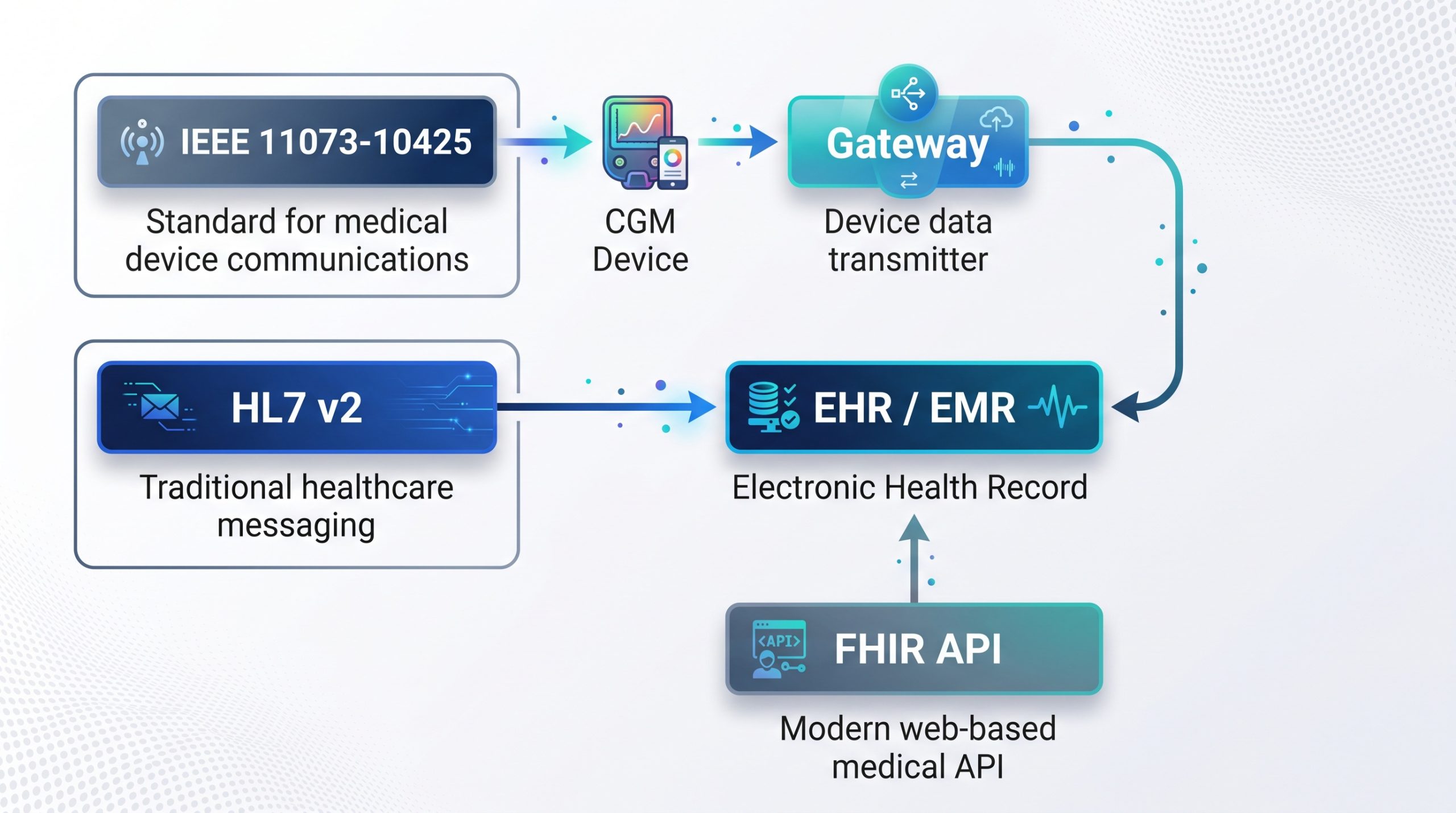
A production CGM integration often uses more than one of these, or uses vendor-specific APIs alongside them. The right architecture follows the actual endpoints, not whichever standard has the most recent revision date.
CGM Integration vs. Remote Patient Monitoring
These are related but distinct, and the distinction matters most when billing gets involved.
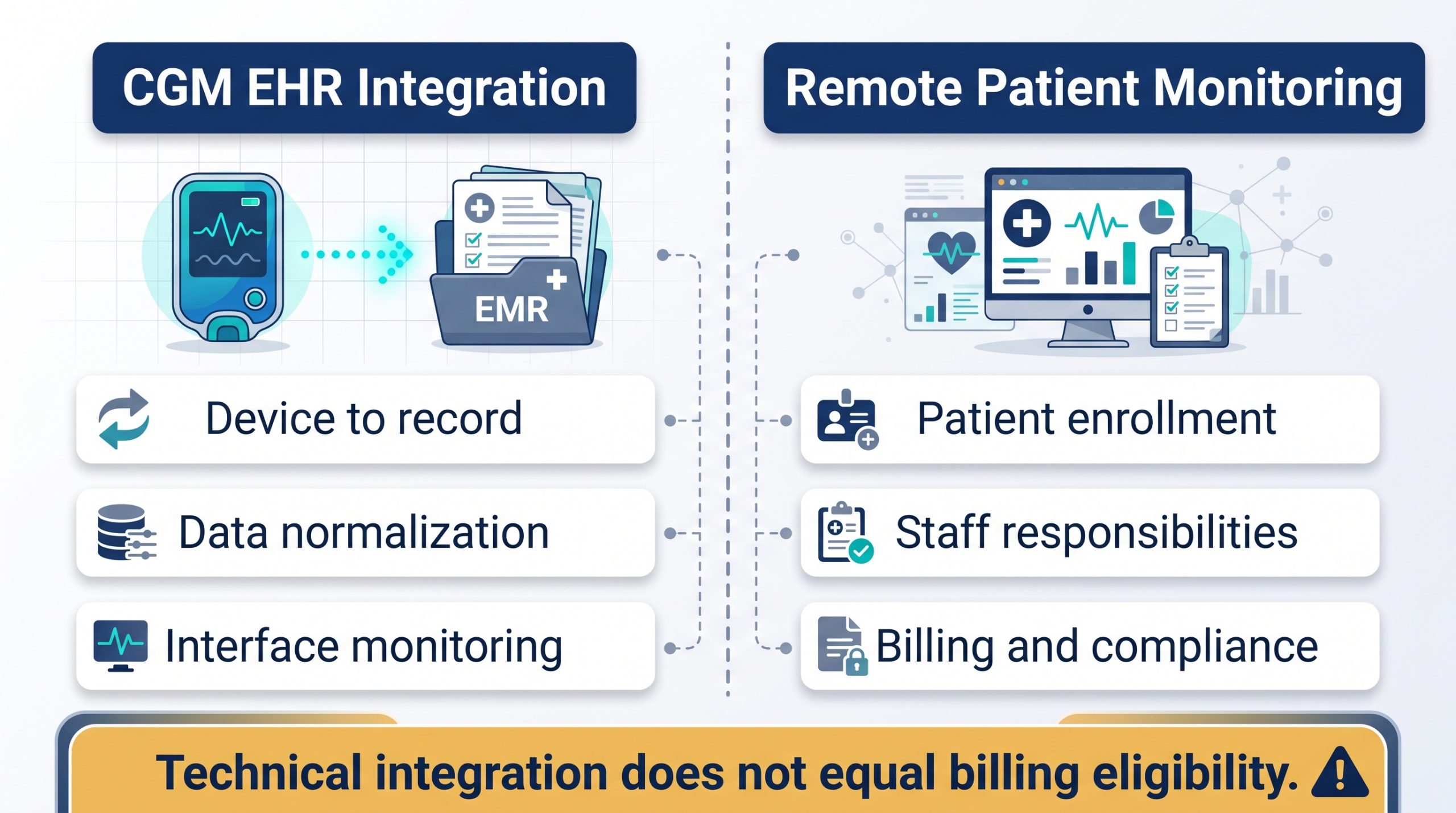
CGM EHR integration is a technical capability. It moves data from a device ecosystem into a clinical record. Remote patient monitoring integration is a broader operational model, one that includes patient enrollment, review workflows, staff responsibilities, documentation requirements, and reimbursement eligibility. Connecting CGM data to an EHR doesn’t establish that a service satisfies a specific billing code.
CMS billing rules for remote physiologic monitoring have separate documentation, time threshold, and patient eligibility requirements. As of 2026, CMS has also proposed requiring that clinical staff performing monitoring be directly employed by the billing practice rather than outsourced, a change that would affect a significant number of existing RPM arrangements if finalized. Technical integration logs don’t cover the compliance requirement. Organizations should validate current CMS RPM requirements separately.
Security and Governance
CGM data is protected health information. That’s where governance planning starts, not where it ends.
Security requirements should be documented per connection, not borrowed from a generic architecture. Specific items worth locking down for each implementation:
- Authentication method for each system-to-system connection
- Encryption standards covering data in transit and at rest
- Role-based access controls defining who sees what inside the EHR
- Patient matching procedures and the process for resolving mismatches
- Interface log retention and audit trail scope
- Incident response procedures for failed transactions, delayed data, or endpoint outages
- Defined responsibilities across the health system, device vendor, EHR vendor, and integration partner
Borrowing a security posture from a previous integration and assuming it applies is a reliable way to introduce a PHI exposure.
What to Define Before a CGM Integration Project Starts
Most CGM integration projects run late or over budget because design decisions got deferred. A few questions left unanswered in week two become rework in week ten. These are the ones worth answering before development begins:
- Which CGM manufacturer and product family is in scope
- Where the integration obtains data: directly from the device, a gateway, a mobile app, or the manufacturer’s cloud
- Authentication and authorization method per connection
- Patient matching logic and the process for corrections
- Data elements, units, and status information to be exchanged
- Whether the EHR receives raw readings, selected observations, summary documents, or some combination
- Terminology mapping requirements and the code sets the destination system expects
- Destination EHR system and version
- Error handling, retry behavior, and monitoring ownership
- Clinical review and validation workflow before go-live
- Privacy, security, consent, and data retention requirements
- Whether any billing workflow is in scope and who validates it
Where Lifepoint Informatics Fits
Lifepoint Informatics builds its medical device integration services around a specific gap: patient-monitoring devices produce data that EMR and EHR systems weren’t designed to receive directly. Its platform supports patient-monitoring environments including glucose meters and other monitoring devices, with the ability to deliver supported patient data to the referring medical record system or the Lifepoint Provider Portal.
The broader platform covers HL7 interfaces, FHIR API connectivity, EHR integration, mapping and transformation tools, interface monitoring, configurable alerts, and 24/7 operational support. For CGM use cases, the value isn’t in the device connection itself. It’s in what happens after: translating device data into a format the receiving clinical system recognizes, routing it to the right destination, and keeping that interface operational once the implementation team has moved on.
Specific CGM manufacturer compatibility, AGP or Time in Range calculations, and billing workflow support should be confirmed directly with Lifepoint’s Product and Engineering team before any patient-facing deployment or published claim.
Frequently Asked Questions
Can CGM data be integrated into an EHR?
Yes, when the CGM device ecosystem and the receiving EHR both support available exchange methods. The architecture might involve manufacturer APIs, middleware, HL7, FHIR, or document-based exchange, depending on what the actual endpoints support.
Does every sensor reading have to go into the EHR?
No. The level of detail depends on the clinical workflow and what the receiving system handles well. Some implementations use summary metrics or selected observations. Others support more granular data. The decision should be made before design starts, not discovered after go-live.
Does Lifepoint support medical device integration?
Yes. Lifepoint’s published materials describe patient monitoring device integration that connects supported device data with EMR/EHR environments and the Lifepoint Provider Portal.
Can CGM integration support RPM billing workflows?
Integration supports the movement and availability of device data. Whether that satisfies a specific billing code depends on the applicable CPT code, CMS requirements, documentation completeness, and payer policy. Those need to be validated separately from the technical build.
Building a CGM Interoperability Strategy That Holds Up
Most CGM integrations that fail didn’t fail because of a bad technology choice. They failed because the design started with a vendor’s capabilities instead of the actual clinical workflow. Before any configuration work begins, nail down the supported CGM source, what clinicians need to see inside the EHR, and what form that data takes when it gets there. Patient matching logic and data representation decisions made late in a project don’t get quietly fixed. They get reworked, and rework on a live clinical interface is expensive.
Pick interoperability methods that fit the real environment, not the reference architecture in a sales deck. Build monitoring in from day one. Governance doesn’t get easier to retrofit after the first patient record goes through.
Health systems and medical device companies working through these questions can contact Lifepoint Informatics to talk through the specific device, EHR, workflow, and data requirements for their project.