Choosing between a lab outreach portal and a direct EMR interface is a false choice. Portals launch in hours, cost less, and validate orders before they reach accessioning, but they add a separate login. EMR interfaces give high-volume practices in-chart ordering, but bring vendor fees and long IT queues. Lifepoint Informatics solves this with a hybrid model that pairs the Lifepoint Informatics Provider Portal with Lifepoint Informatics EMRHub, backed by over 25 years of integration code developed since 1999.
The Connectivity Dilemma in Diagnostic Outreach
Referring physicians drive outreach growth, and they work under tight time limits. If ordering a panel takes too many steps, or retrieving results interrupts charting, they send high-margin outpatient specimens to national reference labs.
Laboratory sales and IT leaders must decide how to connect referring practices to the central Laboratory Information System (LIS):
- Web-based outreach portal: A secure browser gateway for computerized physician order entry (CPOE), barcode label generation, and PDF result retrieval.
- Direct EMR interface: A bi-directional HL7 or FHIR pipeline linking the provider’s EHR to your LIS for in-chart ordering and discrete result filing.
Treating this as an either/or decision creates roadblocks. Building interfaces for low-volume accounts burns IT capital, while forcing large health systems onto a standalone portal drives physician churn.
Portal vs. EMR Interface at a Glance
| Factor | Outreach Portal | EMR Interface |
|---|---|---|
| Best for | Solo providers, PSCs, POLs, new accounts | Multi-specialty groups, clinics, FQHCs |
| Launch time | Hours to days | 3 to 9 months (traditional) |
| Cost | Low, with no EHR vendor fees | $2,000 to $10,000+ per interface |
| Biggest drawback | Separate login | Vendor queues and ongoing mapping upkeep |
How the Hybrid Architecture Works
Both connectivity paths feed one normalized data stream:
| Layer | What Happens |
|---|---|
| Referring practices | Low-to-mid volume sites use the portal; high-volume groups use a bi-directional EMR interface |
| Lifepoint Informatics EMRHub | Unified ingestion, dynamic translation tables (LOINC / ICD-10 / CPT), and 24/7/365 queue and interface monitoring |
| Central LIS | Receives a clean, discrete data stream for accessioning, testing, and verification |
Deep Dive: The Lab Outreach Provider Portal
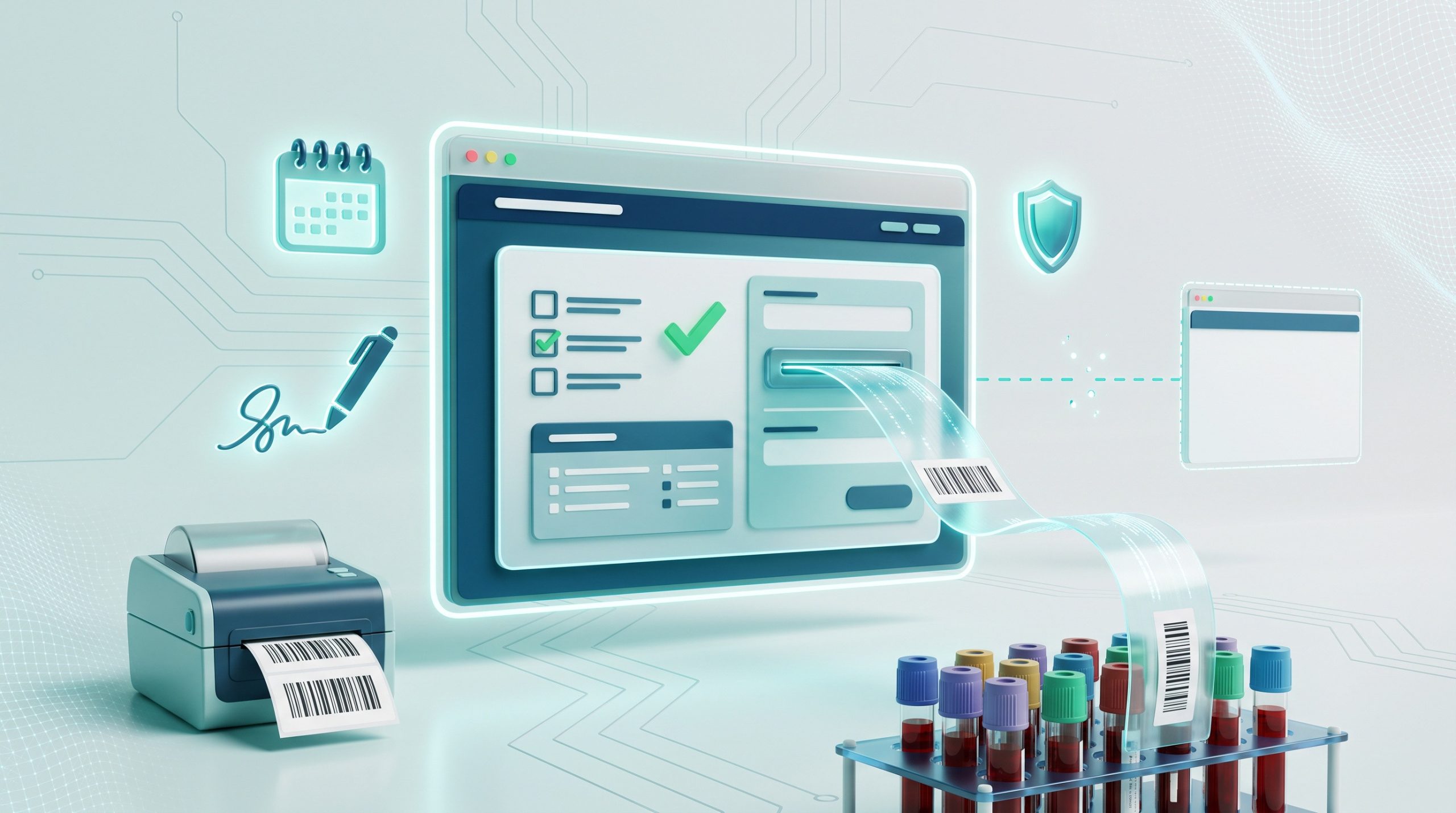
The Lifepoint Informatics Provider Portal acts as a digital front door for clinics without direct electronic interfaces. It gives referring practices a secure, browser-based way to place orders, print labels, and retrieve results, with no EHR vendor involvement and no waiting on an IT queue.
Core Strengths
- Rapid activation: Outreach teams can onboard a practice in hours. Staff receive secure credentials, review a short orientation walkthrough, and start ordering tests immediately. New accounts begin sending electronic orders on day one instead of waiting months for an interface slot.
- Pre-analytical validation: The Lifepoint Informatics Insurance Eligibility Checking Module runs HIPAA 270/271 queries across 700+ payers in real time. It catches inactive policies and transposed subscriber IDs before they reach accessioning, which cuts billing denials and rework downstream.
- Point-of-collection labeling: TruPrint Labels let phlebotomists print instrument-ready barcodes tied to the digital requisition. That eliminates hand-labeled tubes, reduces pre-analytical redraws, and keeps specimens moving from courier drop-off to the analyzer.
- Complex order handling: Standing Orders and Draw Calendars, electronic physician and patient signatures, and Advance Beneficiary Notice (ABN) generation all work natively. These are workflows that ambulatory EHRs often handle poorly.
- Low financial barrier: No EHR vendor is involved, so there are no third-party connection fees. Laboratories can serve low-volume accounts profitably without committing IT capital to each one.
Limitation
- The separate login: Staff must leave their EHR and open a browser to place an order or pull a result. For a practice placing a handful of requisitions a day, that is a minor inconvenience. For practices placing 50+ requisitions a day, double entry becomes a real source of friction. Staff retype patient demographics, switch between systems mid-encounter, and risk transcription errors. Over time, that friction can push high-volume physicians toward competitors who offer in-chart ordering.
- Why it matters for strategy: This limitation is the main reason Lifepoint Informatics recommends a tiered approach. Low-to-mid volume practices stay on the portal, where the separate login costs little. High-volume groups move to a direct EMRHub interface once their order volume justifies it, and they keep portal access as a backup for EHR downtime and complex standing orders.
Deep Dive: The Direct Bi-Directional EMR Interface
A direct interface powered by Lifepoint Informatics EMRHub connects the clinic’s EHR (Epic, Oracle Health, Athenahealth, eClinicalWorks, NextGen, and others) to your LIS.
Core Strengths
- Native workflow: Physicians order tests inside the patient chart during the encounter.
- Discrete results: Finalized results return as HL7 ORU^R01 or FHIR DiagnosticReport messages and populate flowsheets for longitudinal graphing and decision support.
- High-volume retention: Large groups, federally qualified health centers (FQHCs), and hospital-affiliated clinics often require direct connectivity as a contract condition.
Limitations
- Vendor fees: EHR vendors commonly charge $2,000 to $10,000+ per interface in setup and annual maintenance.
- Long queues: Without specialized middleware management, vendor queues can delay deployment by 3 to 9 months.
- Mapping upkeep: Test code mappings, LOINC cross-references, and orderable-to-resultable tables need ongoing maintenance as menus change.
Side-by-Side Comparison
| Parameter | Provider Portal | EMR Interface | Lifepoint Informatics Hybrid |
|---|---|---|---|
| Time to launch | Hours to days | 3 to 9 months | Days for the portal; weeks for EMRHub |
| Implementation cost | Low | Moderate to high | Optimized ROI across account tiers |
| User experience | Standalone login | Native in EHR chart | Matched to account volume |
| Billing checks | Real-time 270/271 eligibility | Depends on EHR billing modules | Integrated across all intake channels |
| Barcode labeling | TruPrint barcodes | Requires clinic EHR label setup | Standardized at point of collection |
| Result delivery | Branded PDFs, cumulative tables | Discrete flowsheet data | Discrete data plus branded PDF |
| Mobile and STAT alerts | Mobile-friendly browser view | EHR-dependent | OutreachMD push alerts (iOS/Android) |
| Complex orders | Standing orders and ABNs | Standard CPOE panels only | Full standing order engine and exceptions |
The Hybrid Strategy: Match the Connection to the Account
High-growth outreach labs deploy both options in tiers.
Tier 1: High-Volume Accounts → Direct EMRHub Interface
Large practices, surgical groups, and primary care networks ordering dozens of requisitions daily get a bi-directional interface. Lifepoint Informatics pre-built adapters for 100+ ambulatory EHRs shorten launch schedules from months to weeks.
Tier 2: Low-to-Mid Volume and New Accounts → Branded Provider Portal
Solo practitioners, rural clinics, specialty providers, and accounts still waiting in an interface queue can send clean electronic orders on day one. That captures revenue right away and protects specimen margins.
Tier 3: Universal Results Dispatch and Mobile Engagement
Even with an EMR interface, clinical teams want backup channels for after-hours review and critical values. Lifepoint Informatics adds:
- OutreachMD Mobile App: Real-time push alerts for critical and abnormal results.
- TruFax Automated Cloud Faxing: High-resolution PDF routing to backup destinations with automated retry logic.
- AI PDF Report Module: Narrative interpretations and trend graphs embedded in the official PDF report.

Fixing Pre-Analytical and Data Translation Bottlenecks
A hybrid model protects lab operations at common failure points:
- Dynamic code mapping: Converts external clinic test codes into your exact LIS dictionary, preventing unmapped order exceptions.
- Integrated exception handling: Orders with mismatched demographics go to the Manual Result Entry and Exception Handling Module, where intake staff fix them with one-click lookups.
- Automated barcode alignment: Portal orders generate TruPrint barcodes, so specimens go from courier drop-off to analyzers without relabeling.
- Predictive business intelligence: Leaders track ordering patterns, turnaround times, and physician retention through conversational AI queries in ReportHub AI.
Security, Compliance, and Governance
Outreach networks must meet privacy and security rules set by the U.S. Department of Health & Human Services and the NIST Cybersecurity Framework. Lifepoint Informatics builds these safeguards into every portal order and EMR interface transmission.
Encryption
- Lifepoint Informatics protects all orders and results with AES-256 encryption at rest and TLS 1.3 in transit.
Audit Trails
- Unalterable, time-stamped logs capture every transmission, demographic correction, result view, and fax confirmation.
- These logs keep laboratories ready for CAP, CLIA, and HIPAA audits.
Role-Based Access
- PHI access is limited by credentialed role across hospital staff, client physicians, and practice administrators.
High Availability
- Cloud-native architecture prevents transaction loss during peak accessioning periods or maintenance windows.
Billing and Interoperability Alignment
- Lifepoint Informatics aligns with CMS clean-claim requirements, including 270/271 eligibility checks, ICD-10 cross-referencing, and automated ABN generation.
- The platform also supports the 21st Century Cures Act interoperability rules.

Why Laboratories Partner with Lifepoint Informatics
Lifepoint Informatics has been a recognized authority in healthcare middleware, EHR interoperability, and outreach technology for more than two decades.
- Established in 1999: 25+ years of integration code built for edge-case transformations and non-standard hospital EHR dialects.
- Unified middleware: Portal orders and direct EHR feeds merge into one normalized LIS stream, so you maintain fewer interfaces.
- Turnkey engineering: Lifepoint Informatics specialists handle interface design, translation table mapping, and clinical validation testing, which frees internal IT teams.
Explore more on our outreach solutions and integration services pages.
Frequently Asked Questions
Can a practice start with the portal and move to an EMR interface later?
Yes. Many programs onboard new practices onto the Lifepoint Informatics Provider Portal first. Once volume justifies it, Lifepoint Informatics deploys an EMRHub interface without interrupting active testing.
Does an EMR interface eliminate the need for a portal?
No. Practices with direct interfaces still use the portal during EHR downtime, for multi-draw standing orders, for multi-year lab trend lookups, and for specialized diagnostic PDFs.
How does Lifepoint Informatics handle non-standard HL7 variants?
Lifepoint Informatics maintains proprietary translation code dating to 1999. It parses non-standard delimiters, custom segment headers, and legacy message structures that cause generic interface tools to drop transactions.
What hardware do draw stations need for the portal?
The Lifepoint Informatics Provider Portal runs on standard desktop browsers and tablets. TruPrint supports desktop thermal label printers, such as Zebra, and standard office laser printers.
How much does an EMR interface typically cost?
EHR vendors commonly charge $2,000 to $10,000+ per interface in setup and annual maintenance. Portals avoid those third-party fees.
Ready to Modernize Client Connectivity?
The Lifepoint Informatics hybrid architecture removes the trade-off between speed and clinical integration. You can onboard practices in hours, connect enterprise health systems through direct EHR feeds, and capture more regional diagnostic market share. Contact Lifepoint Informatics to schedule a custom platform demonstration.