Should your laboratory offer a Provider Portal, direct EMR Interfaces, or both? EMR interfaces deliver the in-chart ordering and discrete results high-volume health systems demand, but they require vendor coordination and lengthy setup. Portals launch in days with no EHR vendor fees, but they add a browser login. Leading outreach programs skip the either/or choice and deploy a hybrid model with the Lifepoint Informatics Provider Portal and EMRHub, backed by 25+ years of middleware expertise.
The Strategic Crossroads in Laboratory Outreach Connectivity
In diagnostic outreach, connectivity determines commercial success. Whether managing a hospital outreach department, a regional clinical laboratory, or a specialized anatomic pathology practice, your referring clinicians operate under intense daily time constraints. If ordering a test panel or reviewing a critical finding introduces workflow friction, physicians will redirect outpatient specimens to commercial reference mega-labs.
To capture and retain community provider business, laboratory directors and IT executives must choose how to link referring practices to the central Laboratory Information System (LIS):
- Option 1: The Provider Portal Strategy. Deploy an encrypted, browser-based web application allowing physician offices to place computerized physician order entry (CPOE) requests, generate specimen labels, and retrieve diagnostic PDF reports.
- Option 2: The Direct EMR Interface Strategy. Construct bi-directional HL7 or FHIR pipelines connecting the clinic’s Electronic Health Record (EHR) directly into the laboratory’s LIS for native chart ordering and discrete result filing.
- Option 3: The Hybrid Connectivity Strategy (Both). Offer a unified digital ecosystem where low-to-mid volume accounts access a branded web portal on day one, high-volume accounts connect via direct EMR interfaces, and all clients share redundant mobile and cloud delivery channels.
Viewing this choice as a rigid binary often leads to business failure: building custom interfaces for low-volume accounts drains IT budgets, while forcing large enterprise practices onto a standalone portal leads to provider churn.
Architectural Comparison: Portal vs. EMR Interface vs. The Hybrid Approach
Understanding the operational mechanics of each deployment path allows laboratory leadership to align connectivity investments with client testing volume and clinical workflow expectations.
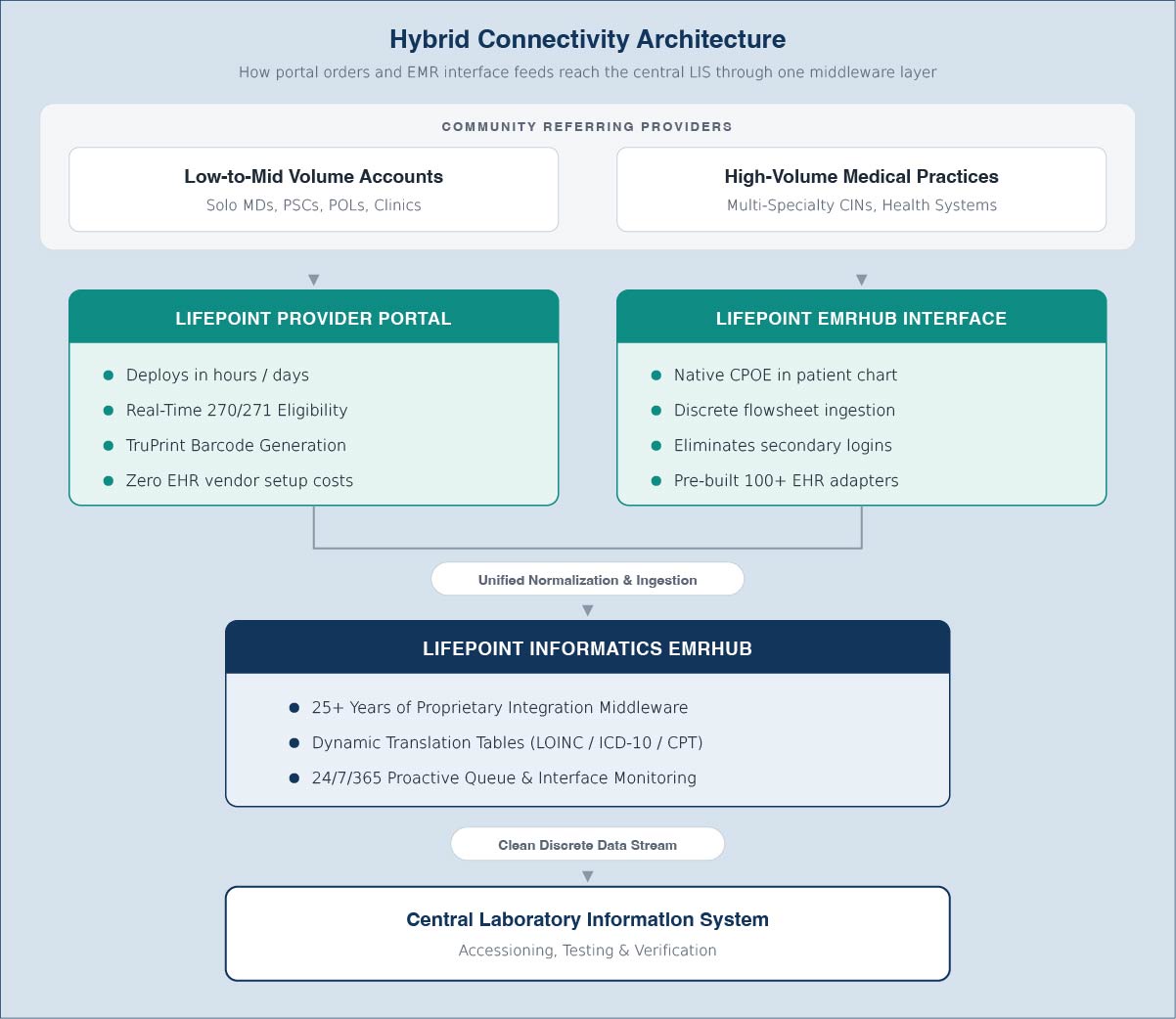
| Layer | Who It Serves | Key Capabilities |
|---|---|---|
| Lifepoint Provider Portal | Low-to-mid volume accounts (Solo MDs, PSCs, POLs, Clinics) | Deploys in hours; real-time 270/271 eligibility; TruPrint barcodes; zero EHR vendor setup costs |
| Lifepoint EMRHub Interface | High-volume practices (Multi-Specialty CINs, Health Systems) | Native CPOE in patient chart; discrete flowsheet ingestion; no secondary logins; 100+ pre-built EHR adapters |
| Lifepoint Informatics EMRHub | Both channels | 25+ years of integration middleware; LOINC / ICD-10 / CPT translation tables; 24/7/365 interface monitoring |
| Central LIS | Receives a clean discrete data stream | Accessioning, testing & verification |
Detailed Evaluation: The Provider Portal
A modern laboratory web portal, such as the Lifepoint Informatics Provider Portal, acts as an immediate digital front door for community practices.
When a Provider Portal Excels
- Rapid Time-to-Market: Portals can be provisioned in hours. When sales representatives acquire a new account, staff can be credentialed, trained, and placing electronic orders the same day.
- Upfront Pre-Analytical Validation: The Lifepoint Informatics Insurance Eligibility Checking Module runs real-time HIPAA 270/271 checks across more than 700 payers, verifying coverage, copays, and deductibles before blood is drawn.
- Point-of-Collection Barcode Labeling: Phlebotomists print instrument-ready barcode labels synchronized with the electronic order using TruPrint, preventing mislabeled tubes and sample redraws.
- Complex Workflow Support: Portals easily manage workflows that standard ambulatory EHRs handle poorly, including Standing Orders, interactive draw calendars, Electronic Signatures, and Advance Beneficiary Notice (ABN) generation.
- No Third-Party EHR Fees: The laboratory avoids the expensive interface setup and maintenance fees charged by commercial EHR vendors.
When a Portal Falls Short Alone
- The “Secondary Screen” Hurdle: Medical assistants and clinicians must leave their primary EHR to open a web browser. For high-volume clinics placing 50 or more requisitions daily, dual-system entry causes workflow friction.
Detailed Evaluation: Direct EMR Interfaces
A direct bi-directional interface, powered by Lifepoint Informatics EMRHub, establishes an automated electronic bridge between the clinic’s native EHR (e.g., Epic, Oracle Health / Cerner, Athenahealth, eClinicalWorks, or NextGen) and your central LIS.
When an EMR Interface Excels
- Native Clinical In-Chart Ordering: Physicians order tests directly within the patient encounter screen, without opening external websites or re-typing demographics.
- Discrete Flowsheet Ingestion: Finalized results return via HL7 ORU^R01 or FHIR DiagnosticReport transactions, populating discrete fields for longitudinal graphing and clinical decision support.
- Securing Enterprise Volume: Large multi-specialty practices, federally qualified health centers (FQHCs), and hospital-owned clinics routinely mandate direct EHR connectivity as a prerequisite for sending diagnostic work.
When an EMR Interface Falls Short Alone
- EHR Vendor Setup Costs & Queues: Commercial EHR vendors often charge thousands of dollars per interface connection and introduce 3-to-9-month implementation waitlists.
- Lack of Pre-Analytical Control: If an external EHR has poorly maintained demographic or insurance records, dirty data flows straight into the interface, requiring manual intervention during accessioning.
- Compendium Code Maintenance: Internal test dictionaries, CPT updates, and LOINC mappings require continuous monitoring to prevent unmapped order exceptions.
Side-by-Side Comparison Matrix
| Strategic Parameter | Provider Portal Only | Direct EMR Interface Only | Lifepoint Informatics Hybrid Ecosystem (Both) |
|---|---|---|---|
| Speed to First Order | Hours to days | 3 to 9 months (traditional) | Immediate portal launch; parallel interface build |
| EHR Vendor Fees | None | High ($2,000–$10,000+ per site) | Selective deployment based on account ROI |
| Provider Workflow | Separate browser tab | Seamless within EHR chart | Optimized by provider volume tier |
| Insurance Verification | Real-time 270/271 checks (700+ payers) | Dependent on clinic EHR accuracy | Automated validation across all intake feeds |
| Point-of-Collection Barcoding | Instrument-ready TruPrint thermal labels | Requires clinic EHR barcode setup | Standardized barcodes for all collection sites |
| Diagnostic Result Format | Clean, branded PDF result reports | Discrete flowsheet data injection | Dual delivery: discrete flowsheet + branded PDF |
| Downtime & Failover Support | None (if portal is down, paper only) | None (if interface drops, results stall) | Automated failover: OutreachMD push & TruFax |
| Complex Order Capabilities | Full standing orders & ABNs | Limited to basic CPOE panels | Comprehensive standing order & signature engine |
Why the Answer Is “Both”: The Lifepoint Informatics Hybrid Strategy
The most successful clinical laboratories do not choose between a portal and an EMR interface. They deploy both as complementary components of a unified outreach ecosystem. By partnering with Lifepoint Informatics, laboratories implement a structured, tiered connectivity strategy.
High-Volume Strategic Accounts (Direct EMRHub Interfaces)
For large medical groups, health centers, and high-volume practices, deploy a direct bi-directional interface using Lifepoint Informatics EMRHub. Pre-built adapters for over 100 ambulatory EHR platforms compress implementation timelines from months to weeks, bypassing hospital IT backlogs while delivering the native in-chart experience clinicians expect.
Low-to-Mid Volume Accounts & Immediate Onboarding (Branded Portal)
For solo practitioners, urgent care centers, specialized outpatient clinics, or newly acquired accounts waiting for an EHR interface build, deploy the Lifepoint Informatics Provider Portal. This captures immediate specimen volume, guarantees clean billing data through real-time insurance verification, and secures provider loyalty from day one.
Universal Redundancy and Mobile Engagement
Even when a practice connects via a direct EMR interface, clinical teams require backup tools during vendor outages or after-hours rounds. Lifepoint Informatics enhances both models with:
- OutreachMD Mobile App: Dispatches real-time smartphone push alerts for critical lab values, panic thresholds, and STAT orders directly to physicians.
- TruFax Automated Cloud Faxing: Automatically routes high-resolution PDF result reports to backup clinical destinations with automated retry logic.
- AI PDF Report Generation: Synthesizes complex numerical panels into clear, narrative clinical interpretations and longitudinal trend graphs embedded within the official PDF report.
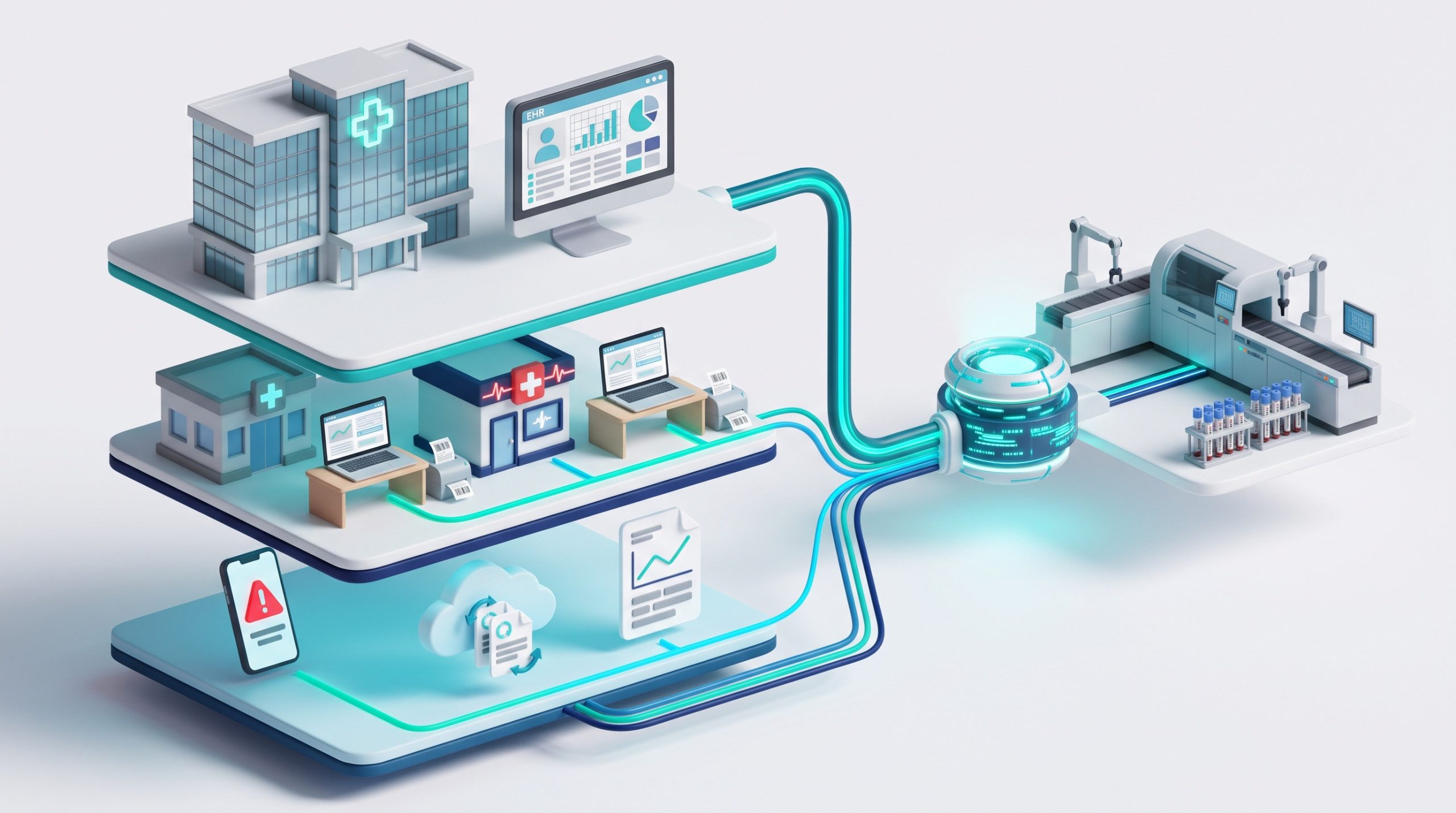
Resolving Operational Disconnects Across the Entire Outreach Pipeline
Deploying a hybrid connectivity model protects central laboratory operations against common pre-analytical points of failure:
- Dynamic Code Mapping: Translates diverse external clinic test codes into your exact internal LIS dictionary codes, preventing unmapped order exceptions.
- Integrated Exception Handling: Orders with mismatched demographics or missing information are routed to the Manual Result Entry & Exception Handling Module, where intake staff quickly correct records using automated lookup tools.
- Automated Barcode Alignment: Portal orders generate instrument-ready barcodes via TruPrint, allowing specimens to move from courier drop-off to analyzers without relabeling.
- Predictive Business Intelligence: Laboratory leadership tracks ordering patterns, turnaround times, and physician retention metrics in real time using conversational AI queries in ReportHub AI.
Enterprise Security, Regulatory Compliance, and Governance
Operating an outreach network requires strict compliance with federal healthcare data privacy and security mandates established by the U.S. Department of Health & Human Services (HHS) and NIST Cybersecurity Guidelines:
- End-to-End Cryptographic Security: Encrypts all electronic orders, mobile push notifications, and laboratory results in transit and at rest using AES-256 and TLS 1.3 standards.
- Audit-Ready Traceability: Generates unalterable, time-stamped logs of every order transmission, demographic correction, result view, and delivery receipt, ensuring readiness for CAP, CLIA, and HIPAA audits.
- Role-Based Access Controls (RBAC): Restricts access to Protected Health Information (PHI) based on credentialed user roles across hospital staff, client physicians, and practice administrators.
- Data Redundancy & High Availability: Cloud-native architecture ensures zero transaction loss during peak accessioning periods or localized hospital network maintenance.
Why Laboratories Partner with Lifepoint Informatics
For more than two decades, Lifepoint Informatics has served as a recognized authority in healthcare middleware, EHR interoperability, and clinical outreach technologies.
- Established in 1999: Over 25 years of battle-tested integration code engineered to manage edge-case transformations and non-standard hospital EHR dialects that generic interface engines cannot resolve.
- Unified Middleware Architecture: Bridge both web portal orders and direct EHR feeds into a single, normalized LIS data stream, eliminating redundant interface maintenance.
- Turnkey Integration Engineering: Lifepoint Informatics specialists manage interface design, translation table mapping, and clinical validation testing, eliminating backlogs for internal hospital IT teams.
Frequently Asked Questions
Why shouldn’t a laboratory rely exclusively on a provider portal?
High-volume physician practices process dozens of patients daily and refuse to leave their primary EHR to place orders or review results. Relying solely on a portal makes these accounts vulnerable to commercial mega-labs that offer direct EHR integration.
Why shouldn’t a laboratory rely exclusively on EMR interfaces?
Building direct EMR interfaces for every referring provider is financially and operationally impractical. Low-volume practices do not generate enough specimen revenue to justify thousands of dollars in EHR vendor interface fees, and during EHR downtime or for specialized standing orders, practices still require web portal access.
Can an account start on the Provider Portal and transition to an EMR interface later?
Yes. Many laboratories onboard new client practices onto the Lifepoint Informatics Provider Portal within 24 to 48 hours. Once specimen volume justifies interface costs, Lifepoint Informatics deploys an EMRHub interface without disrupting active testing operations.
How does Lifepoint Informatics handle different test code dictionaries between clinics and the LIS?
Lifepoint Informatics EMRHub uses dynamic interface translation tables that automatically map external clinic order codes, LOINC terminologies, and ICD-10 diagnosis codes into your laboratory’s exact internal LIS dictionary.
Operational Compliance Standard
The Lifepoint Informatics Operational Compliance Standard guarantees that all portal order feeds and EHR interface transmissions adhere to federal mandates governing patient privacy, electronic data interchange (EDI), and diagnostic data integrity:
- CLIA & CAP Analytical Traceability: An immutable, time-stamped audit log of user IDs, physician signatures, demographic corrections, and result delivery receipts.
- HIPAA & HITECH Security Alignment: ePHI protection across order entry, cloud fax, and mobile with AES-256 at rest, TLS 1.3 in transit, and role-based access controls.
- CMS Clean-Claim & Billing Verification: Pre-accessioning 270/271 eligibility checks, ICD-10 cross-referencing, and automated ABN generation to eliminate billing denials.
- 21st Century Cures Act Interoperability: Non-blocking digital communication between ambulatory providers and hospital laboratories, without proprietary data hoarding.
Deploying the Lifepoint Informatics Hybrid Connectivity Architecture removes the trade-off between speed and clinical integration, allowing your laboratory to onboard practices in hours, connect enterprise health systems via direct EHR feeds, and capture regional diagnostic market share. To learn how Lifepoint Informatics can modernize your client connectivity, contact Lifepoint Informatics today to schedule a custom platform demonstration.