Imaging centers lose outpatient volume when community physicians struggle to order advanced scans or retrieve reports through fragmented, non-CDSM-compliant interfaces. Lifepoint Informatics automates bi-directional RIS, PACS, and EHR connectivity through EMRHub, a branded Provider Portal, and DICOM image delivery, all backed by 25+ years of proprietary middleware.
What Challenges Do Imaging Centers Face Connecting RIS to Ambulatory EHRs?
While clinical pathology deals with numeric values and qualitative tissue descriptions, diagnostic radiology operates under a distinct set of operational and clinical constraints.
Advanced imaging modalities, such as Magnetic Resonance Imaging (MRI), Computed Tomography (CT), Positron Emission Tomography (PET), ultrasound, and digital mammography, demand specific pre-exam screening, detailed patient clinical histories, safety checklists, and prior diagnostic comparison tracking.
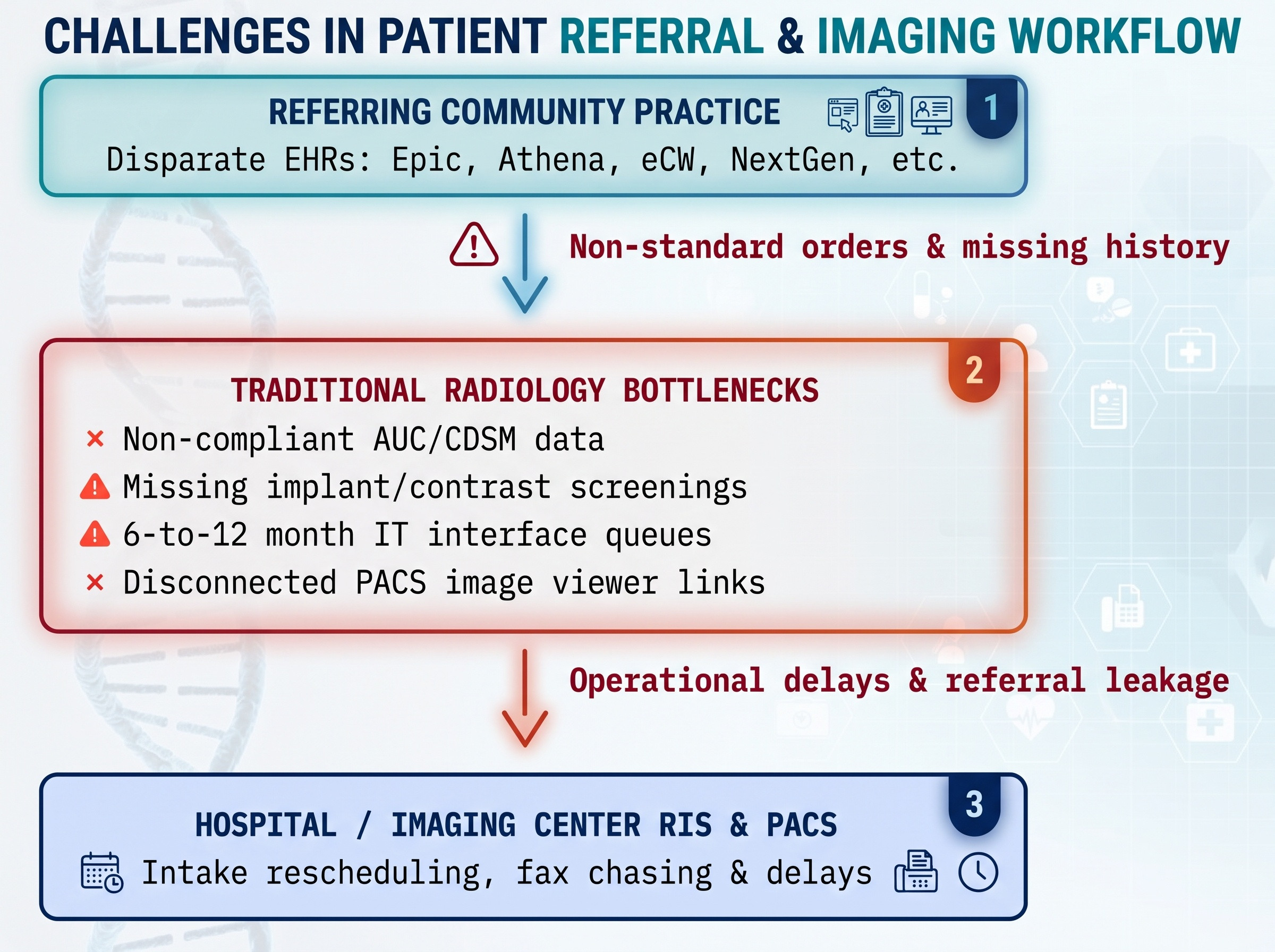
When imaging centers and hospital radiology departments attempt to connect community physician practices using generic interface engines, critical operational bottlenecks emerge:
1. PAMA Appropriate Use Criteria (AUC) and CDSM Hurdles
Under the Protecting Access to Medicare Act (PAMA), outpatient advanced diagnostic imaging orders must include proof of consultation with a qualified Clinical Decision Support Mechanism (CDSM). Standard EHR interfaces often fail to transmit the required Decision Support Number (DSN), consultation modifier, and score, placing Medicare reimbursement at risk.
2. The “N-of-1” Ambulatory EHR Backlog
Independent primary care clinics, orthopedic groups, and neurological practices operate on dozens of distinct outpatient EHR platforms. Building custom HL7 ORM and ORU feeds for each practice strains internal imaging IT teams, resulting in 6-to-12-month backlogs that drive referring physicians toward commercial imaging competitors.
3. Incomplete Pre-Procedural Clinical Data
Imaging studies frequently require critical safety documentation upfront, including renal function labs (eGFR/creatinine) for IV iodinated or gadolinium contrast, surgical implant verifications for MRI scans, and specific ICD-10 indication codes. Handwritten faxes or generic EHR order strings frequently drop these details, forcing radiology staff to spend hours playing phone tag to reschedule patients.
4. Diagnostic Report and Image Link Fragmentation
Clinicians demand more than just the radiologist’s narrative text report; they expect one-click access to the diagnostic DICOM key images. Generic interfaces drop web-viewable PACS links, forcing physicians to log into external imaging portals or wait for mailed patient CDs.
Solving these imaging interoperability bottlenecks requires a specialized, bi-directional integration platform built to bridge the gap between physician EHRs, RIS schedules, and PACS archives.
How Does the RIS-to-EHR Integration Architecture Work?
The Lifepoint Informatics Medical Imaging Integration Engine coordinates seamless, bi-directional data flow between external referring EHRs, central RIS scheduling engines, and diagnostic PACS viewers.
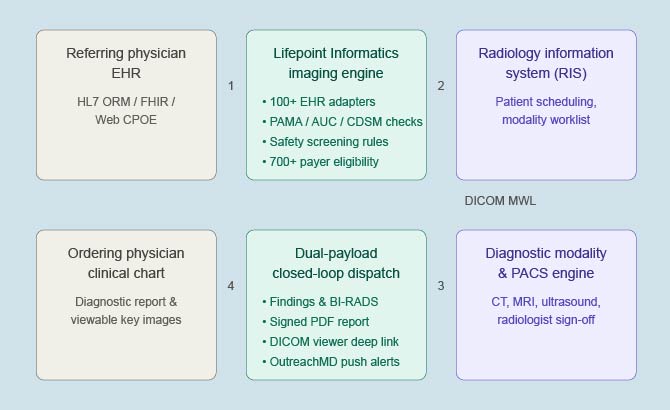
The Lifepoint Informatics engine normalizes incoming orders, validates necessary clinical parameters, and injects clean records into your RIS scheduling worklist. Once the radiologist signs the interpretation, the platform packages the structured text findings, encapsulated branded PDF reports, and zero-footprint web viewer links into a unified transaction delivered directly into the referring physician’s patient chart.
Core Capabilities of the Lifepoint Informatics Radiology Integration Suite
Connecting radiology facilities to ambulatory clinics requires specialized functionality that accounts for imaging protocols, clinical safety guidelines, and complex result formats.
1. Lifepoint Informatics EMRHub: Frictionless Outpatient EHR Connectivity
The Lifepoint Informatics EMRHub acts as a universal gateway connecting your central RIS and PACS to community physician EHRs:
- 100+ Pre-Built Ambulatory Adapters: Direct integration templates for Epic Systems, Oracle Health / Cerner, Athenahealth, eClinicalWorks, and NextGen Healthcare accelerate deployment from months to weeks.
- Dynamic Procedure Code Mapping: Translates diverse external clinic imaging order codes, LOINC identifiers, and CPT codes to match your internal RIS exam compendium.
- PAMA AUC & CDSM Enforcement: Captures and transmits mandatory Appropriate Use Criteria consultation data, adhering to federal Medicare imaging requirements without requiring manual staff intervention.
2. Lifepoint Informatics Provider Portal: Web CPOE for Imaging
For referring clinics that lack direct EHR interfaces, the Lifepoint Informatics Provider Portal delivers a white-labeled, browser-based diagnostic imaging hub:
- Imaging Center Branding: Custom-branded with your imaging center or health system’s logo and color palette to reinforce regional clinical trust.
- Modality-Specific Questionnaires: Prompts ordering staff to complete mandatory clinical safety questionnaires (such as prior contrast reactions, pacemaker verifications, and renal lab values) before orders can be submitted.
- Real-Time Insurance Eligibility Verification: The Lifepoint Informatics Insurance Eligibility Checking Module executes automated HIPAA 270/271 inquiries across 700+ payers, confirming coverage and flagging prior authorization needs upfront.
- Digital Physician Signatures: Captures authenticated CPOE signatures and electronic requisitions using the Electronic Signatures Module.
3. Dual-Payload Result Delivery with Zero-Footprint PACS Viewing
Referring physicians require complete clinical documentation alongside immediate visual access to diagnostic scans:
- Discrete Findings & Standardized Scoring: Ingests discrete findings, overall impressions, and standardized classification scores (such as BI-RADS, Lung-RADS, and LI-RADS) directly into the receiving EHR flowsheet.
- Encapsulated Branded PDF Reports: Transmits finalized, multi-page diagnostic reports featuring your facility’s branding and the radiologist’s digital signature via our Custom PDF Result Report Module.
- Integrated PACS Web-Viewer Links: Embeds secure, zero-footprint DICOM viewer URLs directly into the EHR result message, allowing referring clinicians to view diagnostic key images with a single click.
4. Critical Findings & Emergency Communication
Radiologists frequently uncover acute or unexpected clinical findings, such as acute pulmonary emboli, intracranial hemorrhages, or critical fractures:
- OutreachMD Mobile App: Dispatches real-time smartphone push alerts for critical imaging findings and urgent STAT reports directly to referring providers via the OutreachMD Mobile App.
- TruFax Automated Cloud Faxing: Automatically routes high-resolution PDF diagnostic reports to backup clinical destinations with automated retry logic and confirmation tracking via the TruFax Engine.
Architectural Comparison: Generic Interface Tools vs. Lifepoint Informatics
| Technical Parameter | Generic Interface Engine Toolkit | Custom In-House Scripting | Lifepoint Informatics Medical Imaging Suite |
|---|---|---|---|
| Time to Launch New Clinics | 3 to 6 months per clinic | 6 to 12 months internal IT backlog | Days to weeks via pre-built EMRHub adapters |
| PAMA / AUC / CDSM Support | Often missing; requires add-ons | High custom development burden | Automated ingestion & compliance validation |
| PACS Image Viewer Links | Drops URL parameters | Unreliable custom field mapping | Deep-linked zero-footprint DICOM web URLs |
| Pre-Procedure Safety Checks | Free-text order lines only | Manual clinic phone calls | Structured safety questionnaires in portal |
| Insurance Verification | None (discovered post-exam) | None | Real-time 270/271 checks across 700+ payers |
| Handling Non-Standard HL7 | Breaks on non-standard dialects | Vulnerable to software upgrades | Backed by 25+ years of proprietary middleware code |
| Mobile Critical Alerting | None (manual phone tag) | None | Native OutreachMD mobile push alerts |
| Client Churn Visibility | Fragmented spreadsheets | Discovered months later in billing | ReportHub AI predictive churn detection alerts |
Protecting Outreach Imaging Margins with ReportHub AI
Scaling an imaging outreach network requires real-time insight into referring physician ordering trends. The Lifepoint ReportHub AI Module continuously tracks diagnostic transaction streams in real time:
- Predictive Churn Detection: Uses machine learning models to identify subtle downward trends in an orthopedic or primary care group’s weekly scan referrals, flagging accounts at risk of defection weeks before standard billing reports show a decline.
- Turnaround Time (TAT) Tracking: Monitors scan lifecycles from patient scheduling and exam completion through radiologist sign-off and EHR delivery, pinpointing imaging transcription or review bottlenecks before clients complain.
- Conversational Natural Language Analytics: Allows imaging center directors to ask conversational questions (e.g., “Show me all referring practices with declining MRI volume over the past 30 days”) to generate instant, exportable retention reports.
Enterprise Security, Regulatory Compliance, and Governance
Transmitting diagnostic imaging reports, patient safety histories, and DICOM viewer links across external healthcare networks requires adherence to federal cybersecurity and data integrity frameworks established by the U.S. Department of Health & Human Services (HHS) and NIST Cybersecurity Guidelines:
- End-to-End Cryptographic Security: Transports all HL7, FHIR, and API transactions in transit using TLS 1.3 and at rest using AES-256 standards across secure VPN tunnels.
- Deterministic Diagnostic Integrity: Employs automated checksum validation to guarantee that qualitative narrative findings, radiologist impressions, and standardized scoring data are delivered without text truncation or altered formatting.
- Audit-Ready Traceability: Maintains immutable, time-stamped transaction logs of every imaging order, demographic correction, radiologist sign-off, and result acknowledgment to satisfy ACR accreditation and HIPAA audit requirements.
- Role-Based Access Controls (RBAC): Restricts access to sensitive diagnostic scans, patient histories, and Protected Health Information (PHI) based on credentialed user roles across imaging center staff and external referring clinicians.
Why Diagnostic Imaging Providers Choose Lifepoint Informatics
Imaging centers and hospital radiology departments partner with Lifepoint Informatics because we solve the connectivity and workflow challenges that cause outpatient scan volume to leak away. By deploying over 25 years of specialized integration code, Lifepoint Informatics enables radiology providers to:
- Onboard referring ambulatory practices in weeks, eliminating internal hospital IT backlogs.
- Replace manual paper requisitions and missing clinical histories with structured electronic CPOE.
- Deliver finalized diagnostic reports complete with embedded zero-footprint PACS viewer links directly into provider EHR charts.
- Protect outpatient imaging margins and retain referring physician loyalty across the regional healthcare community.
Frequently Asked Questions (FAQs)
How does Lifepoint Informatics support PAMA and CDSM requirements for advanced imaging?
The platform captures and validates mandatory Clinical Decision Support Mechanism (CDSM) consultation data, including the Decision Support Number (DSN), consultation modifier, and appropriateness rating, within the electronic order stream, passing it cleanly into your RIS to ensure full Medicare billing compliance.
Can referring clinicians view actual diagnostic images, or only the text report?
Both. Lifepoint Informatics EMRHub delivers the radiologist’s narrative text and discrete impressions directly into the EHR chart, while embedding a secure, encrypted link to a zero-footprint DICOM viewer. Clinicians click the link to inspect key diagnostic images without leaving their browser.
Which RIS and PACS platforms does Lifepoint Informatics support?
Lifepoint Informatics integrates with all major commercial and proprietary RIS and PACS systems, including Epic Radiant, Cerner RadNet, Sectra, GE Healthcare, Philips, Intelerad, and Fujifilm, using standard HL7, HL7 FHIR, DICOM, REST APIs, or custom flat files.
What options are available for referring practices that lack a direct EHR interface?
Physician practices without an electronic interface can use the web-based Lifepoint Informatics Provider Portal. Clinicians place CPOE orders, complete pre-exam safety checklists, verify insurance eligibility, and retrieve finalized diagnostic reports and image links through an intuitive, branded interface.
Operational Compliance Standard
Radiology data exchange across ambulatory networks must align with federal mandates on patient privacy, electronic data interchange (EDI), and data integrity. The Lifepoint Informatics Operational Compliance Standard ensures every order feed, requisition, and report transmission adheres to:
- PAMA & CMS AUC Traceability: Validates and logs every advanced imaging order against qualified CDSM guidelines before RIS scheduling, protecting reimbursement.
- HIPAA & HITECH Security: Protects ePHI with AES-256 encryption at rest, TLS 1.3 in transit, and role-based access controls.
- CMS Clean-Claim Verification: Runs real-time 270/271 eligibility checks, ICD-10 cross-referencing, and pre-authorization validation to prevent billing denials.
- 21st Century Cures Act Interoperability: Enables non-blocking clinical communication between ambulatory providers and radiology facilities, with no proprietary data hoarding.
Deploying the Lifepoint Informatics Medical Imaging Solution converts complex imaging orders and diagnostic report delivery into an automated, legally compliant, and closed-loop clinical bridge, eliminating transcription errors, accelerating exam turnaround times, and cementing long-term physician relationships across your healthcare community. To learn how Lifepoint Informatics can elevate your radiology department’s connectivity, contact Lifepoint Informatics today to schedule a custom platform demonstration.