Outreach labs need athenahealth connectivity to win regional ambulatory business, but integration means handling one ORM^O01 message per test, strict tie-to-order matching, and compendium mapping. Lifepoint Informatics EMRHub solves this with bi-directional CPOE, real-time order normalization, point-of-collection barcoding, and automated exception routing, backed by 25+ years of middleware code.
Why Is athenahealth Connectivity Critical for Modern Outreach Laboratories?
athenahealth is one of the most widely adopted cloud-based electronic medical records (EMRs) and practice management platforms in the United States, supporting thousands of independent primary care groups, multi-specialty clinics, and federally qualified health centers (FQHCs).
For an outreach laboratory, being able to accept electronic orders directly from an athenahealth clinic and deliver discrete results back into the patient encounter is vital. When community practices evaluate diagnostic providers, they prioritize workflow speed:
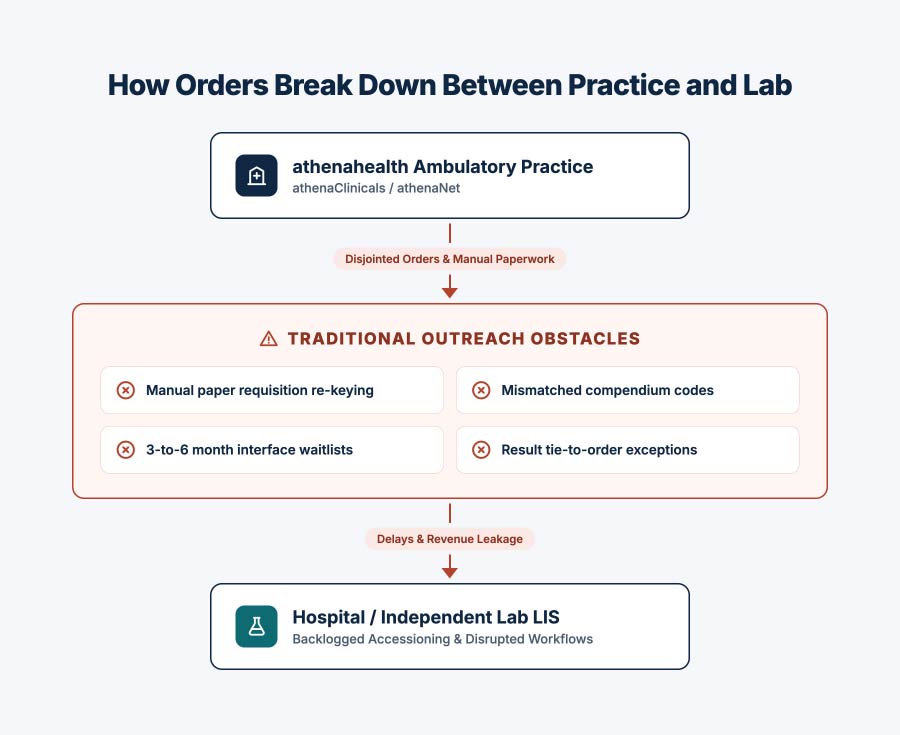
When an outreach laboratory attempts to connect to athenaClinicals without a dedicated middleware bridge, critical operational bottlenecks occur:
- Result Tie-To-Order Matching Failures: athenahealth relies on strict “tie-to-order” logic to match inbound laboratory results to the corresponding open order in athenaClinicals. If the incoming result message drops the original Order ID or alters the clinical encounter ID, the result cannot tie automatically, landing in an administrative exception inbox for manual staff intervention.
- The “One ORM per Test” Data Structure: Unlike hospital-based LIS environments that group multiple panels under a single accession number, the athenaNet interface engine historically dispatches individual ORM messages for each separate test ordered within an encounter. Ingestion engines that cannot assemble and synchronize these split transactions flood the laboratory accessioning desk with duplicate order records.
- Compendium Mapping and Maintenance Queues: Aligning an outside lab’s internal test dictionary with an athenahealth practice’s Order Types (CPOT) requires ongoing maintenance. Updating custom reflex rules, LOINC identifiers, and ICD-10 clinical diagnostic codes can lead to interface rejections if not managed dynamically.
- Interface Deployment Overhead: Managing direct point-to-point connections with dozens of individual athenahealth practices drains internal laboratory IT resources, delaying account onboarding and driving physician volume to commercial mega-labs.
To establish reliable, scalable connectivity with athenahealth practices, laboratories need a specialized middleware integration layer.
How Does the athenahealth-to-LIS Integration Architecture Work?
The Lifepoint Informatics EMRHub platform acts as a universal bi-directional translation engine between athenahealth practices and the laboratory’s central Laboratory Information System (LIS).
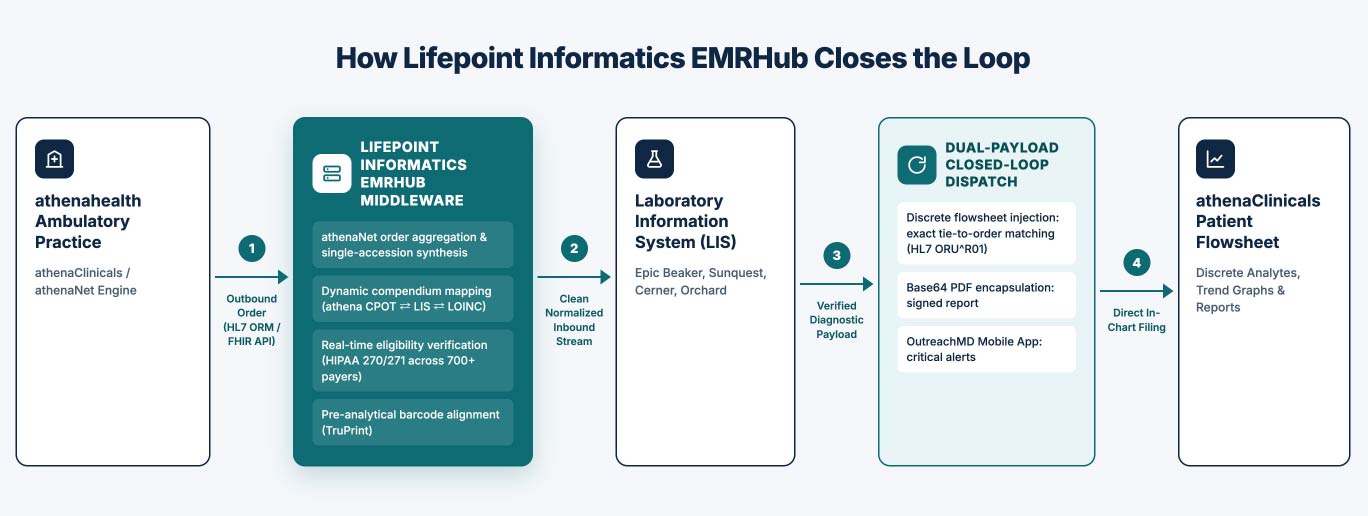
The Lifepoint Informatics engine intercepts outbound order transactions from athenaNet, validates clinical demographics, verifies insurance status in real time, and synthesizes individual test orders into a unified accession for your LIS. Once testing is complete, Lifepoint Informatics EMRHub formats the discrete results to preserve the exact Order ID and encounter parameters required for automated tie-to-order filing in athenaClinicals.
Core Technical Standards for athenahealth Connectivity
Connecting an outreach laboratory to athenahealth practices requires supporting both established messaging protocols and emerging web standards:
1. HL7 v2.3 / v2.5.1 Interface Specifications
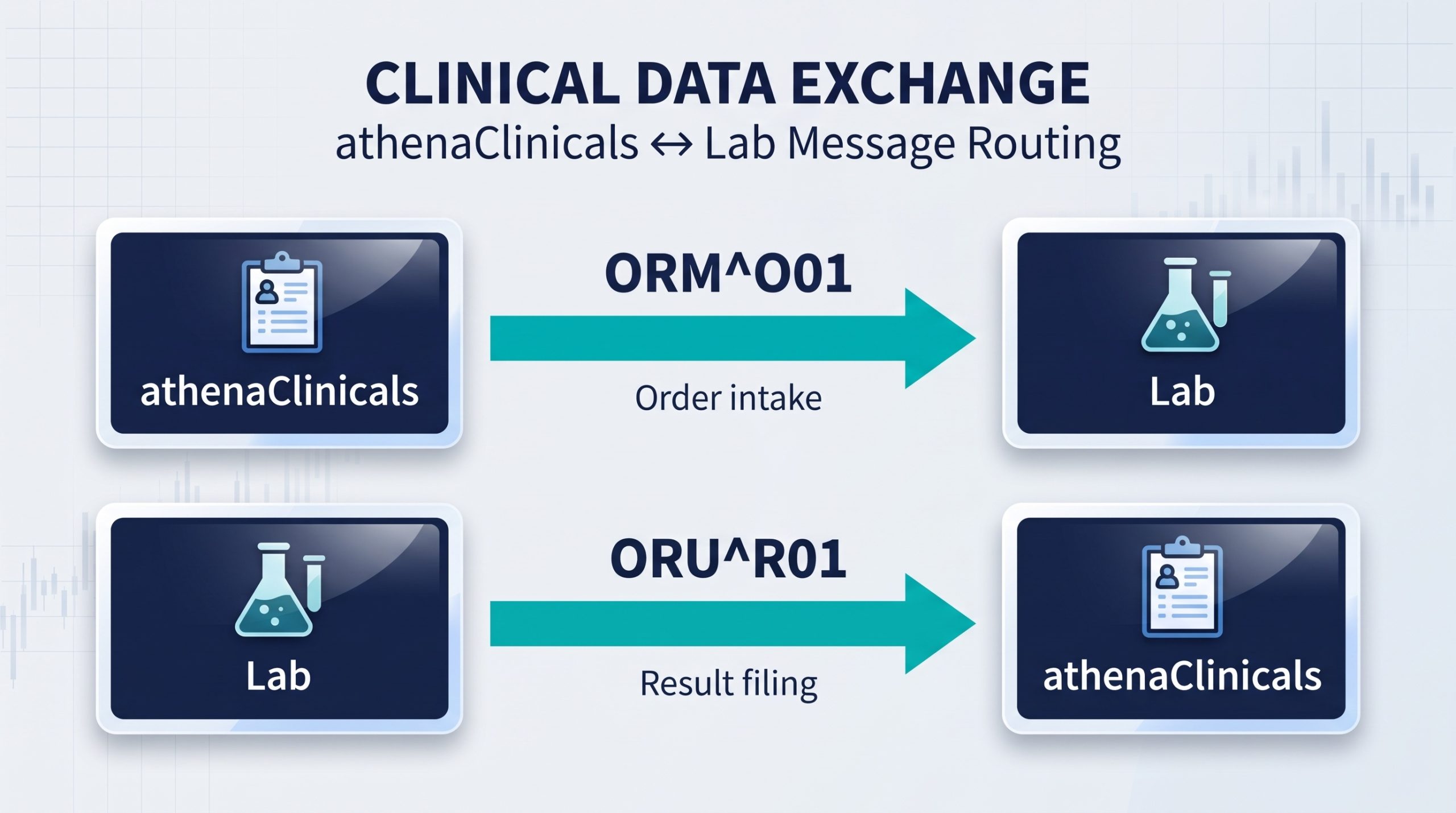
- Order Intake (ORM^O01): athenaClinicals transmits outbound electronic orders as HL7 ORM messages containing patient demographics, clinical encounter IDs, ordering provider NPIs, and diagnostic ICD-10 codes. Lifepoint Informatics normalizes these transactions, ensuring all tests ordered within the same clinical encounter map into a single accession.
- Result Filing (ORU^R01): Results are delivered via unsolicited observation messages (ORU^R01). Lifepoint Informatics dynamically injects the mandatory Placer Order Number and Filler Order Number into OBR-2 and OBR-3, guaranteeing that athenahealth’s automated engine links the results directly to the open order document in the patient chart.
2. Modern HL7 FHIR RESTful APIs
- The Standard: athenahealth provides RESTful HL7 FHIR APIs to support modern, web-scale healthcare data exchange.
- The Lifepoint Informatics Advantage: Lifepoint Informatics EMRHub bridges legacy LIS platforms with modern athenahealth FHIR resources, such as DiagnosticReport and Observation, translating traditional database outputs into JSON payloads.
3. Dual-Payload Delivery (Discrete Analytes + Branded PDF)
- Clinical Value: Physicians in athenaClinicals need discrete analyte values for automated flowsheet graphing, cumulative review, and clinical quality measures (CQMs). However, clinicians also require visual diagnostic reports for complex panels, pathology interpretations, and reflex profiles.
- The Lifepoint Informatics Advantage: Lifepoint Informatics simultaneously files discrete observations into athenaClinicals flowsheets while encapsulating high-resolution PDF reports (via Base64 within OBX-5) directly into the patient’s encounter document tab.
Overcoming Common athenahealth Integration Roadblocks
Integrating with community athenahealth practices presents technical hurdles that can derail deployment if not managed proactively:
1. Eliminating Split-Order Accessioning Headaches
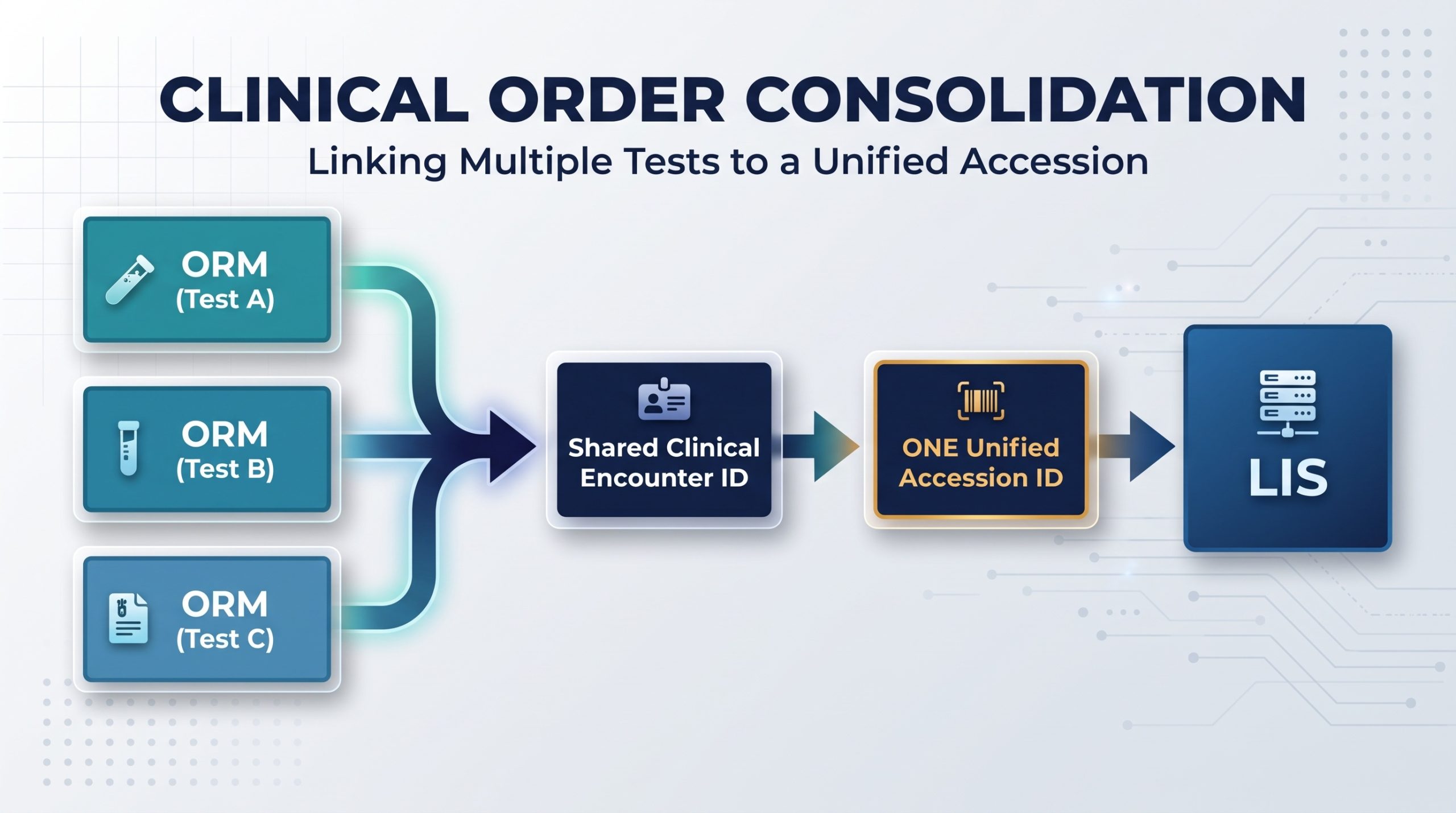
Because athenaNet historically dispatches an individual ORM message for every test ordered in an encounter, traditional lab intake systems often create separate accession numbers for each test. Lifepoint Informatics EMRHub reconciles these messages using the shared Clinical Encounter ID, combining them into a single, clean accession for your laboratory staff.
2. Point-of-Collection Barcode Labeling with TruPrint
Mismatched specimen labels cause substantial delays during central laboratory intake. Through TruPrint Labels, clinic staff and phlebotomists print instrument-ready thermal barcode labels synchronized with the electronic athenahealth order. When tubes arrive at the central laboratory, accessioning staff scan barcodes directly into automated analyzers without manual transcription.
3. Upfront Insurance Verification to Eliminate Denials
Electronic orders from ambulatory clinics frequently contain expired insurance details or transposed subscriber IDs. The Lifepoint Informatics Insurance Eligibility Checking Module executes automated HIPAA 270/271 checks across more than 700 commercial, Medicare, and Medicaid payers during order intake, flagging inactive policies before testing begins.
4. Multi-Channel Failover and Mobile Alerts
If an athenahealth practice experiences network downtime or connection drops, diagnostic results must not stall:
- OutreachMD Mobile App: Dispatches real-time smartphone push alerts for critical panic values, abnormal findings, and STAT orders directly to clinicians via the OutreachMD Mobile App.
- TruFax Automated Cloud Faxing: Transmits high-resolution, HIPAA-compliant PDF result reports to backup clinical destinations with automated retry and failover routing via the TruFax Engine.
- Lifepoint Informatics Provider Portal: Provides 24/7 web-based ordering and result lookup through the branded Lifepoint Informatics Provider Portal.
Architectural Comparison: athenahealth Integration Approaches
| Operational Parameter | In-House Lab IT Development | Generic Middleware Tools | Lifepoint Informatics Managed EMRHub |
|---|---|---|---|
| Time to Launch | 3 to 6 months per practice | 2 to 4 months per practice | Days to weeks via pre-built athena adapters |
| Tie-To-Order Success | High risk of detached results | Moderate exception rate | 100% deterministic tie-to-order matching |
| Split-Order Handling | Creates duplicate accessions | Requires custom scripting | Automated encounter-level order aggregation |
| Compendium Mapping | Manual spreadsheet reconciliation | Basic text substitution | Dynamic translation tables (CPOT ⇄ LIS ⇄ LOINC) |
| Clean-Claim Checks | Discovered post-testing by billing | Basic syntax checks | Real-time 270/271 insurance verification |
| Specimen Labeling | Hand-labeled collection tubes | Generic label tools | Instrument-ready TruPrint thermal barcodes |
| Client Churn Visibility | Discovered months later in billing | Fragmented spreadsheets | ReportHub AI predictive churn detection alerts |
Enterprise Security, Regulatory Compliance, and Governance
Transmitting electronic Protected Health Information (ePHI) into external athenahealth environments requires adherence to health system IT governance, federal cybersecurity rules, and standards enforced by the U.S. Department of Health & Human Services (HHS) and NIST Cybersecurity Guidelines:
- End-to-End Cryptographic Security: Transports all HL7, FHIR, and API transactions in transit using TLS 1.3 and at rest using AES-256 standards across secure VPN tunnels.
- Deterministic Data Integrity: Prevents clinical value truncation, missing decimal points, or altered reference ranges through automated checksum verification and schema validation.
- Audit-Ready Traceability: Maintains immutable, time-stamped transaction logs of every message received, validated, and acknowledged to satisfy College of American Pathologists (CAP) and Clinical Laboratory Improvement Amendments (CLIA) inspection requirements.
- Role-Based Access Control (RBAC): Restricts interface configuration settings, translation dictionaries, and patient records strictly to authorized clinical personnel.
Why Laboratories Partner with Lifepoint Informatics for athenahealth Connectivity
Clinical and anatomic pathology laboratories partner with Lifepoint Informatics because we eliminate the operational barriers that stall outreach growth. By deploying over 25 years of specialized integration code, Lifepoint Informatics enables laboratories connecting to athenahealth practices to:
- Launch community EHR interfaces in weeks, eliminating internal IT backlogs.
- Prevent accessioning bottlenecks through automated order normalization and encounter grouping.
- Guarantee seamless in-chart filing via deterministic tie-to-order result delivery.
- Protect outpatient testing margins and retain high-value referral volume across regional athenahealth medical groups.
Frequently Asked Questions (FAQs)
How does Lifepoint Informatics ensure results link directly to the open order in athenaClinicals?
athenaClinicals requires exact matching parameters to tie an inbound result to an open order document. Lifepoint Informatics EMRHub captures the unique Order ID, Clinical Encounter ID, and placer order numbers from the inbound ORM message and maps them cleanly into the outbound ORU segments (OBR-2, OBR-3), ensuring 100% automated tie-to-order filing.
How are multi-test orders handled when sent from athenahealth?
athenaNet dispatches individual ORM messages for each test ordered during a patient visit. Lifepoint Informatics EMRHub correlates these messages using the shared Clinical Encounter ID, combining them into a unified accession before transmitting the requisition to your LIS.
Can Lifepoint Informatics connect our LIS to both athenahealth and other EHRs like Epic?
Yes. Lifepoint Informatics maintains an extensive library of pre-built adapters for more than 100 ambulatory EHR platforms, including athenahealth, Epic Systems, Oracle Health / Cerner, eClinicalWorks, and NextGen, allowing your lab to connect to all community practices through a single integration pipeline.
What happens if an ordering clinic’s interface goes offline?
The Lifepoint Informatics Interface Dashboard actively monitors data pipelines around the clock. If a clinic’s endpoint goes offline, transactions are safely queued, and critical results can fail over automatically to the OutreachMD Mobile App, TruFax Cloud Faxing, or the web-based Lifepoint Informatics Provider Portal.
Operational Compliance Standard
Managing diagnostic laboratory data exchange across ambulatory networks requires strict alignment with federal mandates governing patient privacy, electronic data interchange (EDI), and diagnostic data integrity. The Lifepoint Informatics Operational Compliance Standard guarantees that all athenahealth order feeds and result transmissions strictly adhere to:
- CLIA & CAP Analytical Traceability: Replaces fragmented paper records and unlinked interface streams with an immutable, time-stamped digital audit log capturing user IDs, electronic physician signatures, demographic corrections, and result delivery receipts to satisfy all unannounced laboratory inspection criteria.
- HIPAA & HITECH Security Alignment: Protects electronic Protected Health Information (ePHI) across every order entry screen, cloud fax transmission, and mobile interface using AES-256 encryption at rest and TLS 1.3 in transit, backed by granular role-based access controls.
- CMS Clean-Claim & Billing Verification: Enforces pre-accessioning 270/271 real-time eligibility inquiries, mandatory ICD-10 diagnosis cross-referencing, and automated ABN generation to eliminate billing denials and ensure Medicare compliance.
- 21st Century Cures Act Interoperability Mandates: Guarantees seamless, non-blocking digital clinical communication between ambulatory care providers and hospital laboratory testing facilities without proprietary data hoarding.
Deploying the Lifepoint Informatics EMRHub Platform transforms athenahealth connectivity into an automated, legally compliant, and closed-loop diagnostic Bridge, eliminating transcription errors, accelerating turnaround times, and cementing long-term physician relationships across your healthcare community. To learn how Lifepoint Informatics can streamline your athenahealth lab integrations, contact Lifepoint Informatics today to schedule a custom platform demonstration.