Hospital laboratories have spare testing capacity, local courier routes, and pathology expertise. Yet they lose regional market share because community practices run dozens of different Electronic Health Record (EHR) platforms. Internal point-to-point builds create 6-to-12-month IT backlogs, and paper requisitions cause pre-analytical errors and rejected claims. Lifepoint Informatics solves this with EMRHub, dynamic order normalization, pre-built adapters for 100+ ambulatory EHRs, and more than 25 years of proprietary middleware code developed since 1999.
What Challenges Do Hospital Laboratories Face When Connecting to Community Provider EHRs?
Hospital laboratories are the natural diagnostic center of their regional healthcare communities. But outpatient medical groups, independent primary care practices, and specialty clinics rarely use the hospital’s internal system. Instead, they run a fragmented mix of ambulatory EHRs, including Epic Systems, Oracle Health / Cerner, Athenahealth, eClinicalWorks, and NextGen Healthcare.
Without specialized healthcare middleware, four hurdles emerge:
- The 6-to-12-month IT backlog. Clinics expect fast setups, but hospital IT teams are already stretched across inpatient applications. Multi-month delays frustrate providers and send business to commercial mega-labs.
- The “N-of-1” EHR fragmentation problem. No two ambulatory EHR installations format data identically. Custom delimiters, proprietary test mnemonics, and non-standard HL7 segments break generic interface scripts during accessioning.
- Pre-analytical accessioning bottlenecks. Without an interface, practices revert to handwritten requisitions. Staff spend hours deciphering handwriting and re-keying demographics, creating a 1% to 3% error rate that slows turnaround time (TAT).
- Billing denials from unverified orders. Paper requisitions often lack active subscriber IDs, secondary coverage, or required ICD-10 codes. Billing finds the inactive policy only after testing, which means claim rework and uncollectible bad debt.
Hospital laboratories need a universal, bi-directional integration layer that connects community practices to the central Laboratory Information System (LIS) without draining internal IT capacity.
How Does the Hospital Lab-to-Community EHR Integration Pipeline Work?
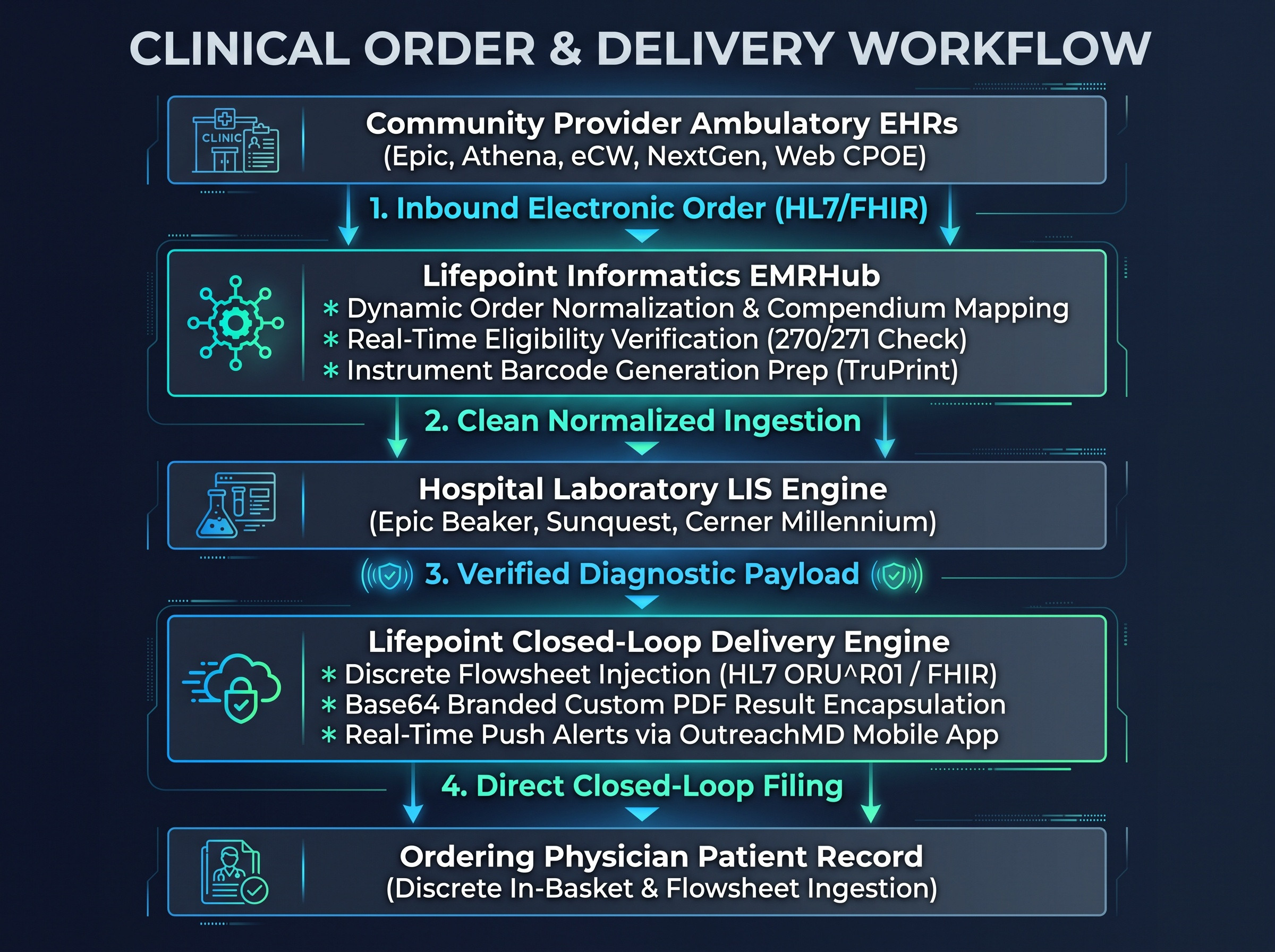
Lifepoint Informatics EMRHub acts as a bi-directional data translation and communication engine. It normalizes incoming computerized physician order entry (CPOE) feeds, maps codes dynamically, and routes clean data into your LIS. After testing, it returns discrete values, abnormal flags, and branded PDF reports to the originating patient record.
| Step | Stage | What Happens |
|---|---|---|
| 1 | Community provider EHR (Epic, Athena, eCW, NextGen, Web CPOE) | Sends an inbound electronic order via HL7 or FHIR |
| 2 | Lifepoint Informatics EMRHub | Normalizes orders, maps the compendium, runs 270/271 eligibility checks, and preps TruPrint barcodes |
| 3 | Hospital LIS (Epic Beaker, Sunquest, Cerner Millennium) | Receives clean, normalized orders for testing |
| 4 | Closed-loop delivery engine | Injects discrete flowsheet values (HL7 ORU^R01 / FHIR), attaches Base64 branded PDFs, and sends push alerts via OutreachMD |
| 5 | Ordering physician’s patient record | Files results directly into the in-basket and flowsheet record |
By decoupling community software from the hospital’s central LIS, Lifepoint Informatics keeps external software updates from disrupting internal workflows.
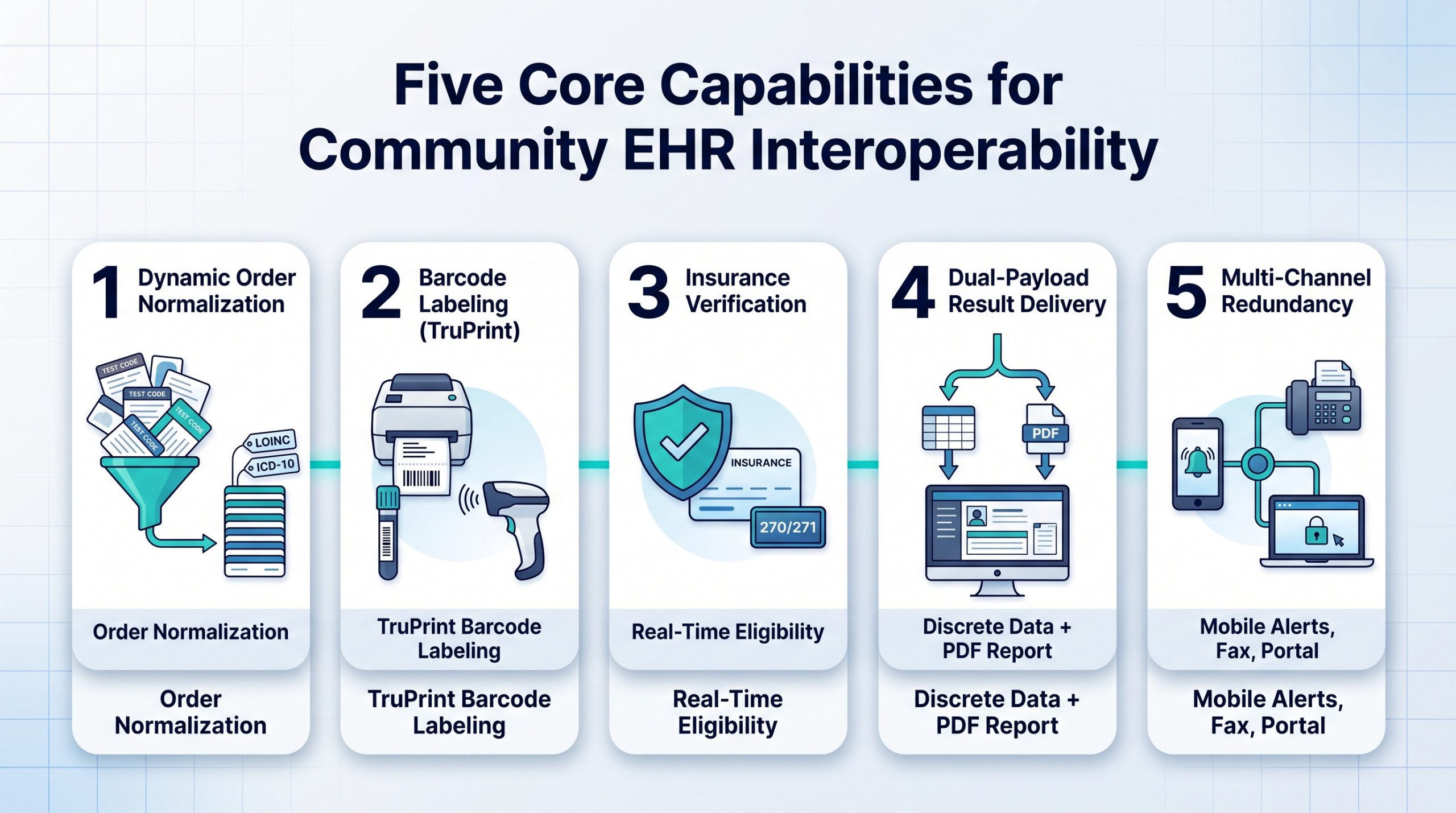
Five Core Capabilities for Community EHR Interoperability
Connecting an outreach laboratory to diverse regional clinics requires five middleware capabilities.
1. Dynamic Order Normalization and Translation Tables
Community practices maintain their own orderable test codes. EMRHub standardizes incoming orders and uses flexible translation tables to map clinic codes, LOINC identifiers, and ICD-10 diagnosis codes to your internal LIS dictionary, without custom programming.
2. Point-of-Collection Barcode Labeling (TruPrint)
Pre-analytical errors are eliminated at the draw chair. With TruPrint, clinic phlebotomists print instrument-ready thermal barcode labels tied to the electronic order. At the hospital, accessioning staff scan barcodes straight into analyzers and skip manual registration.
3. Real-Time Insurance Verification
The Insurance Eligibility Checking Module runs automated HIPAA 270/271 inquiries across 700+ commercial, Medicare, and Medicaid payers during order entry. It flags inactive policies and surfaces copay and deductible requirements before testing begins.
4. Dual-Payload Result Delivery
Clinicians need discrete values for flowsheet graphing, cumulative review, and decision support. They also need formatted reports for complex panels, pathology narratives, and molecular genetics. Lifepoint Informatics delivers both at once: structured components plus Base64-encapsulated reports from the Custom PDF Result Report Module.
5. Multi-Channel Redundancy and Mobile Alerting
If a clinic’s EHR interface drops or hits a firewall issue, results must not stall. Lifepoint Informatics provides three fallbacks:
- OutreachMD Mobile App: instant push alerts for critical values and panic thresholds.
- TruFax Cloud Faxing: high-resolution reports sent to backup clinical destinations.
- Provider Portal: 24/7 web-based ordering and result lookup.
How Do the Integration Options Compare?
Here is how Lifepoint Informatics EMRHub stacks up against the two common alternatives.
| Metric | In-House Point-to-Point | Generic Interface Engine | Lifepoint Informatics EMRHub |
|---|---|---|---|
| Time to launch | 6 to 12 months per clinic | 3 to 6 months per clinic | Days to weeks with pre-built adapters |
| Internal IT burden | High developer and analyst commitment | Ongoing script maintenance | Turnkey, fully managed setup and monitoring |
| EHR coverage | Limited to 1–2 major systems | Generic template mapping | 100+ pre-built ambulatory EHR adapters |
| Order-to-result matching | High risk of orphaned results | Manual table matching | Automated deterministic binding |
| Clean-claim validation | Found after testing by billing | Basic syntax checks | Real-time 270/271 checks (700+ payers) |
| Specimen labeling | Handwritten or mismatched | Generic label tools | Instrument-ready TruPrint barcodes |
| Non-standard dialects | Breaks on custom EHR variants | Stalls on legacy HL7 dialects | Backed by 25+ years of proprietary code |
Edge Cases: Decades of Integration Heritage
Standard HL7 v2 and modern FHIR rarely behave identically across healthcare settings. Legacy EHR installations, non-standard delimiters, customized MSH headers, and proprietary vocabularies cause generic tools to drop transactions.
In business since 1999, Lifepoint Informatics has spent more than a quarter century refining its integration middleware:
- Non-conforming dialects: The codebase handles legacy hospital variants, non-standard HL7 segments, and unique vendor data streams without schema rewrites.
- Centralized exception worklists: Orders with mismatched demographics or unmapped test codes route to the Manual Result Entry and Exception Handling Module, where staff resolve them with one-click lookups.
- Predictive business intelligence: Lab leaders track ordering patterns, turnaround times, and physician retention in real time through conversational AI queries in ReportHub AI.
Enterprise Security, Compliance, and Governance
Connecting hospital systems to ambulatory practices demands strict adherence to frameworks from the U.S. Department of Health & Human Services and NIST.
| Safeguard | What It Does |
|---|---|
| End-to-end encryption | Protects HL7, FHIR, and API transactions with TLS 1.3 in transit and AES-256 at rest across secure VPN tunnels |
| Deterministic data integrity | Checksum verification and schema validation prevent truncated values, missing decimals, and altered reference ranges |
| Audit-ready traceability | Immutable, time-stamped logs of every message satisfy CAP and CLIA inspections |
| Role-based access control | Limits interface settings, translation dictionaries, and patient records to authorized personnel |
Operational Compliance Standard
Lifepoint Informatics order feeds and diagnostic transmissions align with these federal mandates:
- CLIA and CAP traceability: Every requisition, electronic signature, demographic change, and manual result entry carries an unalterable timestamp, user ID, and network source address.
- HIPAA and HITECH: Orders and reports are encrypted with AES-256 and TLS 1.3. The Provider Portal and OutreachMD enforce biometric or role-based authentication.
- CMS medical necessity: Orders are validated against coverage determinations, Advance Beneficiary Notices (ABNs) are captured, and 270/271 checks run before accessioning.
- 21st Century Cures Act: Standardized bi-directional exchange supports information blocking compliance.
Frequently Asked Questions (FAQs)
What role does our hospital IT staff play during a new community EHR integration?
Your IT team only establishes one secure connection between the central LIS and Lifepoint Informatics. Our engineers then handle setup, code mapping, testing, and go-live with the clinic’s EHR vendor.
How does Lifepoint Informatics handle non-standard HL7 implementations?
We maintain proprietary code dating back to 1999, built to manage custom HL7 dialects, non-standard delimiters, and legacy message structures that disrupt generic tools.
What ordering options exist for clinics without an EHR interface?
Clinics can use the web-based Provider Portal to place CPOE orders, verify insurance eligibility, print barcoded manifests, and receive finalized PDF reports.
What happens if a clinic’s EHR goes down?
The Interface Dashboard monitors data pipelines around the clock. If an endpoint goes offline, the system queues transactions and can route critical alerts through OutreachMD or TruFax.
How quickly can a new clinic go live?
Pre-built adapters typically bring connections online in days to weeks, compared with 6 to 12 months for in-house point-to-point builds.
Does EMRHub work with our existing LIS?
Yes. EMRHub connects to hospital LIS platforms such as Epic Beaker, Sunquest, and Cerner Millennium through a single interface.
Is EMRHub vendor neutral, and how is it delivered?
Yes. EMRHub is vendor-neutral and delivered as a hosted software-as-a-service platform. Your lab maintains a single interface to its LIS, which removes the need for custom point-to-point builds and interface engine hardware.
Bring Community EHR Connectivity Under Control
Deploying Lifepoint Informatics EMRHub turns community EHR connectivity into an automated, compliant, closed-loop bridge. It eliminates transcription errors, accelerates turnaround times, and strengthens physician relationships across your network. Contact Lifepoint Informatics to schedule a custom platform demonstration and see how quickly your first community clinic can go live.