Hospital labs running Epic Beaker or Cerner Millennium PathNet often see outreach stall when connecting community clinics. Custom EHR interfaces clog hospital IT queues, and paper requisitions cause errors and unbilled claims. Lifepoint Informatics solves this with EMRHub, a branded Provider Portal, real-time eligibility checks, and multi-channel results delivery, all backed by 25+ years of proprietary middleware code.
Why Do Hospital Outreach Programs Struggle Despite Running Epic or Cerner?
Epic and Cerner represent the gold standard in inpatient electronic medical records and acute-care hospital information systems. Within the hospital’s physical walls, order-to-result workflows are tightly coordinated: computerized orders flow cleanly from floor units into Epic Beaker or Cerner PathNet, and discrete results populate inpatient charts instantly.
However, an ambulatory outreach laboratory is not an inpatient hospital ward. Outreach programs must serve independent community physicians, regional specialty groups, federally qualified health centers (FQHCs), and ambulatory surgery centers (ASCs).
The Outreach Gap at a Glance
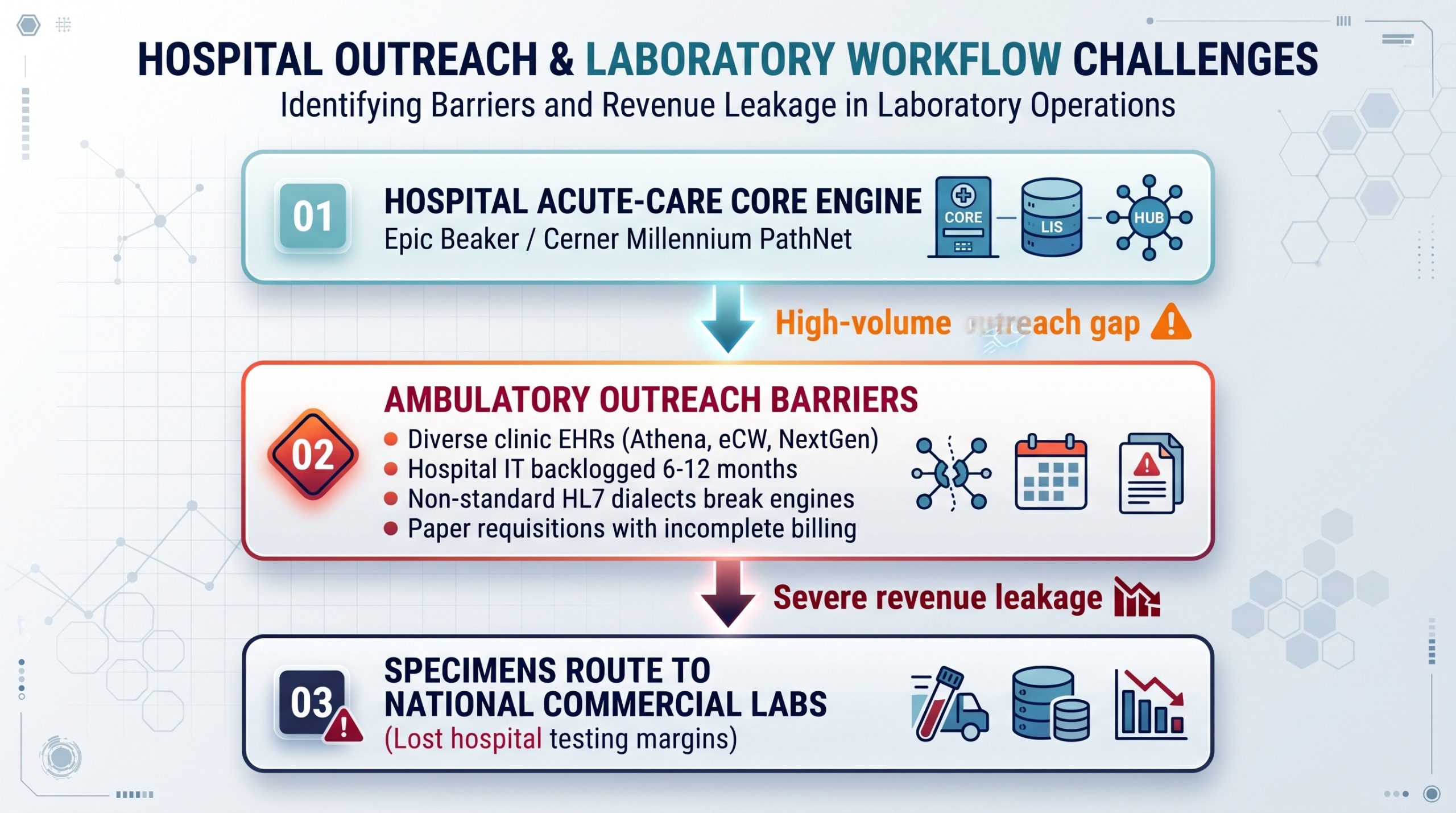
When hospital health systems attempt to scale an outreach business relying solely on native Epic or Cerner interface tools, critical commercial and technical roadblocks emerge:
- The 6-to-12 Month IT Integration Backlog: Community physician practices operate on a fragmented landscape of outpatient EHRs (including Athenahealth, eClinicalWorks, and NextGen Healthcare). Connecting each non-affiliated practice to Epic Bridges or Cerner Open Engine requires internal IT analyst hours. Because internal hospital IT resources are prioritized for hospital system rollouts, external clinic requests sit in queue for 6 to 12 months, prompting clinics to route specimens to commercial mega-labs.
- The High Cost of Non-Standard HL7 Interfaces: Ambulatory EHR installations use custom segment delimiters, non-standard order qualifiers, and proprietary test mnemonics. Writing custom transformation logic within Epic Bridges or Cerner interface tools for every small clinic is cost-prohibitive.
- Accessioning Overload from Paper Requisitions: Practices lacking a direct interface default to handwritten paper forms. Hospital intake personnel spend hours manually deciphering scribbles and keying patient data into Epic Beaker or Cerner PathNet, introducing transcription errors that cause specimen redraws and delayed turnaround times (TAT).
- Pre-Analytical Billing Denials: Orders placed without real-time insurance checks often have expired coverage or missing ICD-10 diagnosis codes. By the time the billing department identifies the error, the test has run, resulting in unpaid claims and write-offs.
Enhancing an Epic or Cerner outreach operation requires a dedicated middleware layer that handles external community integration without draining hospital IT resources.
How Lifepoint Informatics Enhances Epic and Cerner Outreach
The Lifepoint Informatics Outreach Ecosystem acts as a specialized ambulatory bridge surrounding your central Epic or Cerner core. Lifepoint Informatics manages external clinic connectivity, normalizes data, validates pre-analytical information, and feeds clean, standardized HL7 and FHIR transactions directly into your hospital LIS.
The Closed-Loop Outreach Workflow
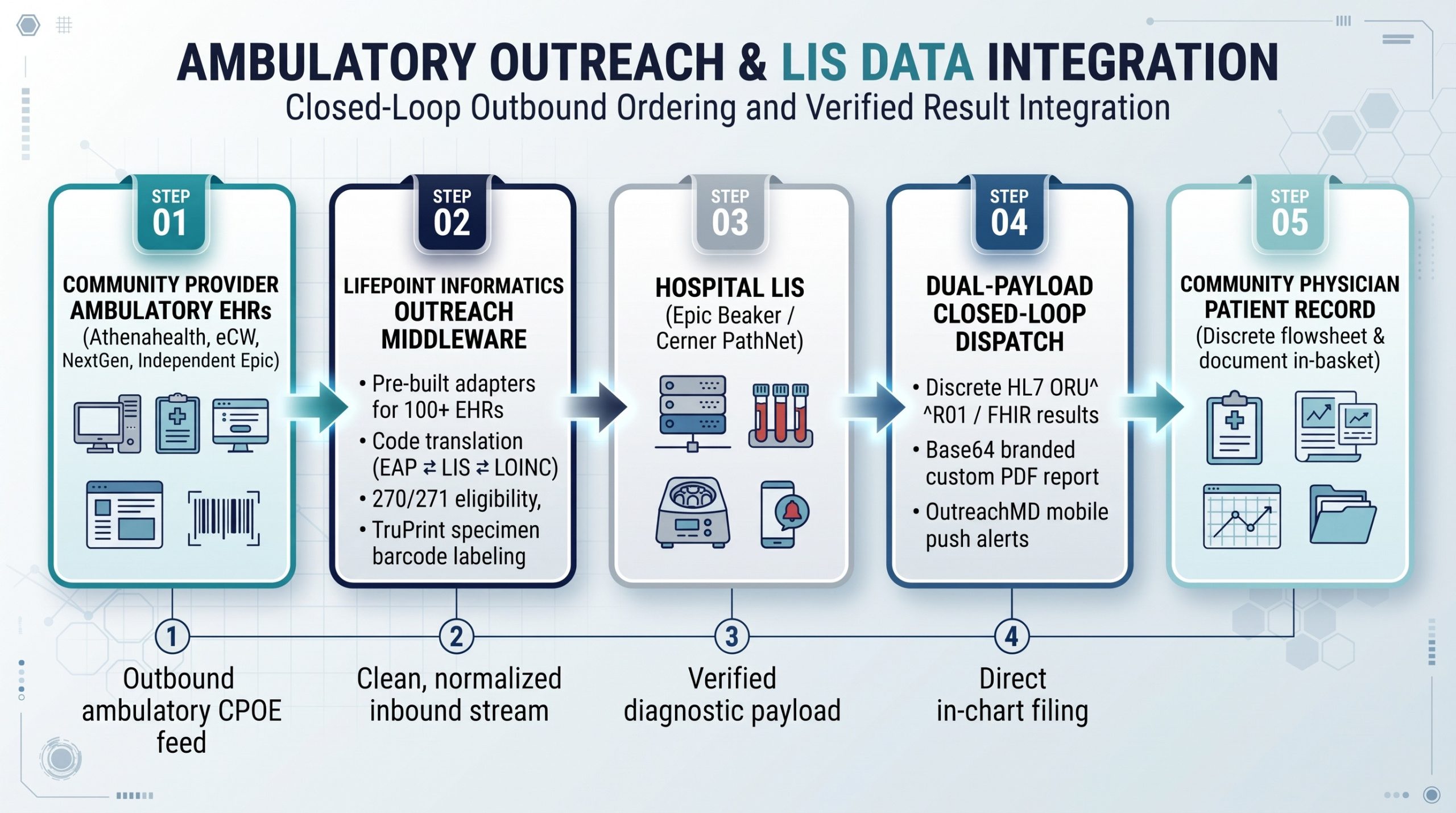
By decoupling external clinic connections from the internal hospital LIS, Lifepoint Informatics protects the stability of your core Epic or Cerner database while onboarding referring practices in weeks rather than months.
Core Capabilities of the Lifepoint Informatics Enhancement Architecture
Lifepoint Informatics complements your existing health system technology through five integrated modules:
1. Lifepoint Informatics EMRHub: Frictionless Outpatient EHR Connectivity
The Lifepoint Informatics EMRHub serves as a universal adapter between your hospital’s Epic or Cerner environment and community practices:
- 100+ Pre-Built Ambulatory Adapters: Connects natively to outpatient EHRs, compressing setup timelines from months to days.
- Dynamic Compendium Mapping: Automatically translates community clinic order codes, LOINC identifiers, and ICD-10 clinical diagnosis codes to match your internal Epic Procedure Master (EAP) or Cerner orderables dictionary.
- Fully Managed Integration Engineering: Lifepoint Informatics engineers handle interface configuration, testing, and go-live validation directly with clinic EHR vendors, relieving hospital IT analysts of external interface maintenance.
2. Lifepoint Informatics Provider Portal: The Digital Front Door
For practices lacking an EHR capable of electronic ordering, the Lifepoint Informatics Provider Portal delivers a white-labeled, web-based CPOE solution:
- Hospital Branding: Custom-branded with your hospital’s logo and color palette to reinforce provider loyalty and health system trust.
- Smart Order Entry: Intuitive test lookup guides office staff to proper collection tubes, required fasting statuses, and custom clinical panels.
- Standing Orders & Draw Calendars: Automates chronic disease monitoring schedules, future-dated draws, and compliance alerts via our Standing Orders Module.
- Electronic Signatures: Captures digital provider attestations and Advance Beneficiary Notices (ABNs) during order entry via our Electronic Signatures Module.
3. Pre-Analytical Insurance Eligibility Verification
Clean claims require verifying coverage before testing occurs. The Lifepoint Informatics Insurance Eligibility Checking Module connects directly to more than 700 commercial, Medicare, and Medicaid payers:
- Executes automated HIPAA 270/271 inquiries during order entry.
- Flags inactive policies and invalid subscriber numbers immediately, preventing costly billing write-offs.
4. Point-of-Collection Barcode Labeling (TruPrint)
Handwritten tube labels are a primary cause of pre-analytical lab errors. Through TruPrint, clinic phlebotomists print instrument-ready thermal barcode labels at collection:
- Labels match incoming Epic or Cerner electronic orders.
- Specimens move directly from courier drop-off to laboratory analyzers without manual accessioning delays.
5. Multi-Channel Results Delivery (OutreachMD & TruFax)
Clinicians need immediate access to diagnostic findings across multiple environments:
| Channel | HEADER 2 |
|---|---|
| Discrete Chart Injection | Ingests discrete test parameters, flags, and reference ranges into external EHR flowsheets.Ingests discrete test parameters, flags, and reference ranges into external EHR flowsheets. |
| OutreachMD Mobile App | Sends real-time push alerts for critical panic values and STAT orders directly to physicians’ smartphones. |
| TruFax Automated Cloud Faxing | Transmits high-resolution, HIPAA-compliant PDF result reports to backup clinical destinations with automated retry and failover routing via the TruFax Engine. |
| AI PDF Report Generation | Synthesizes complex numeric panels into clear clinical narratives and trend graphs embedded directly within official reports via our AI PDF Report Module. |
Architectural Comparison: Native Epic/Cerner vs. Lifepoint Informatics Enhancement
| Strategic Capability | Native Epic / Cerner Outreach Alone | Generic Interface Engine Toolkit | Epic/Cerner + Lifepoint Informatics Enhancement |
|---|---|---|---|
| New Ambulatory EHR Setup | 6 to 12 months internal IT backlog | 3 to 6 months per clinic | Days to weeks via pre-built EMRHub adapters |
| Outreach Portal Experience | Generic web extension | Disconnected portal tool | Fast, intuitive, white-labeled with hospital branding |
| Hospital IT Workload | High internal engineering burden | Ongoing script maintenance | Turnkey, fully managed setup with 24/7 monitoring |
| Clean-Claim Validation | Often post-analytical discovery | Basic format checks | Real-time 270/271 checks across 700+ payers |
| Tube Labeling at Clinic | Requires clinic-side EHR setup | Generic label software | Instrument-ready TruPrint thermal barcodes |
| Handling Non-Standard HL7 | Breaks on non-standard dialects | Stalls on legacy dialects | Backed by 25+ years of proprietary middleware code |
| Mobile Provider Access | Limited to standard portal view | None (manual phone tag) | Native OutreachMD mobile app with push alerts |
| Client Churn Visibility | Discovered months later in billing | Fragmented spreadsheets | ReportHub AI predictive churn detection alerts |
Retaining Outreach Accounts with ReportHub AI
Scaling an outreach program requires actionable insight into client ordering patterns. The Lifepoint ReportHub AI Module continuously tracks diagnostic transaction streams in real time:
- Predictive Churn Detection: Uses machine learning models to identify subtle downward trends in a provider’s weekly ordering volume, flagging accounts at risk of defection weeks before standard billing reports show a decline.
- Turnaround Time (TAT) Tracking: Monitors specimen lifecycles from clinic collection and courier handoff through accessioning and report sign-off, pinpointing logistical delays before clients complain.
- Conversational Natural Language Analytics: Allows outreach managers to query data instantly (e.g., “Show me all internal medicine practices with declining metabolic panel volumes over the past 30 days”).
Enterprise Security, Regulatory Compliance, and Governance
Connecting hospital systems to external ambulatory practices requires strict adherence to federal cybersecurity and data integrity frameworks established by the U.S. Department of Health & Human Services (HHS) and NIST Cybersecurity Guidelines:
- End-to-End Cryptographic Security: Transports all HL7, FHIR, and API transactions in transit using TLS 1.3 and at rest using AES-256 standards across secure VPN tunnels.
- Deterministic Data Integrity: Prevents clinical value truncation, missing decimal points, or altered reference ranges through automated checksum verification and schema validation.
- Audit-Ready Traceability: Maintains immutable, time-stamped transaction logs of every message received, validated, and acknowledged to satisfy College of American Pathologists (CAP) and Clinical Laboratory Improvement Amendments (CLIA) inspection requirements.
- Role-Based Access Control (RBAC): Restricts interface configuration settings, translation dictionaries, and patient records strictly to authorized clinical personnel.
Why Health Systems Choose Lifepoint Informatics
Hospital health systems partner with Lifepoint Informatics because we eliminate the operational and technical barriers that cause outreach programs to stall. By deploying over 25 years of specialized integration code, Lifepoint Informatics enables Epic and Cerner laboratories to:
- Launch community EHR interfaces in weeks, eliminating internal hospital IT backlogs.
- Replace manual paper requisitions and reduce pre-analytical accessioning errors by up to 40%.
- Deliver a seamless digital ordering and discrete reporting experience that matches national reference laboratories.
- Protect outpatient testing margins and retain high-value referral volume within the health system.
Frequently Asked Questions (FAQs)
Does Lifepoint Informatics replace Epic Beaker or Cerner PathNet?
No. Lifepoint Informatics complements and enhances your existing Epic Beaker or Cerner PathNet installation. Your central laboratory continues using Epic or Cerner for core accessioning, testing, and clinical verification, while Lifepoint Informatics manages the external connectivity, code translation, and client-facing tools.
What role does our hospital IT staff play during a new clinic integration?
Internal IT staff only need to assist with establishing a single secure connection between your Epic or Cerner interface engine and Lifepoint Informatics. From that point forward, Lifepoint Informatics engineers handle all setup, code mapping, testing, and go-live tasks directly with community clinic EHR vendors.
How does Lifepoint Informatics handle non-standard HL7 implementations?
Lifepoint Informatics maintains an extensive repository of proprietary translation code dating back to 1999, specifically engineered to parse non-standard delimiters, custom segment headers, and legacy message structures that disrupt generic interface tools.
What ordering options are available for clinics without an EHR interface?
Community practices without an electronic interface can use the web-based Lifepoint Informatics Provider Portal. Clinicians place CPOE orders, verify insurance eligibility, print barcoded manifests, and receive finalized PDF reports through the same unified data architecture.
Operational Compliance Standard
All Lifepoint Informatics order feeds, portal transactions, and result transmissions adhere to federal mandates for patient privacy, electronic data interchange (EDI), and diagnostic data integrity:
- CLIA & CAP Traceability: Immutable, time-stamped audit logs of user IDs, e-signatures, demographic corrections, and delivery receipts, ready for unannounced inspections.
- HIPAA & HITECH Security: AES-256 encryption at rest, TLS 1.3 in transit, and role-based access controls across every portal, fax, and mobile interface.
- CMS Clean-Claim Verification: Real-time 270/271 eligibility checks, ICD-10 cross-referencing, and automated ABN generation to prevent billing denials.
- 21st Century Cures Act: Non-blocking data exchange between ambulatory providers and hospital labs, with no proprietary data hoarding.
Deploying the Lifepoint Informatics Outreach Ecosystem transforms your Epic or Cerner laboratory into an automated, legally compliant, and closed-loop diagnostic bridge, eliminating interface backlogs, accelerating turnaround times, and cementing long-term physician relationships across your healthcare community. To learn how Lifepoint Informatics can enhance your Epic or Cerner laboratory outreach program, contact Lifepoint Informatics today to schedule a custom platform demonstration.