Diagnostic outreach laboratories lose up to 15% to 25% of their active physician client accounts annually due to silent digital attrition. When ordering portals require cumbersome multi-step logins, EHR interfaces take months to build, and diagnostic results fail to file cleanly into patient charts, community practices quietly redirect their specimen volume to commercial competitors. Discover how clinical laboratories eliminate connectivity bottlenecks and portal friction with Lifepoint Informatics. Deploying the white-labeled Lifepoint Informatics Provider Portal, rapid Lifepoint Informatics EMRHub bi-directional connectivity, mobile push alerting via OutreachMD, and early churn intervention through ReportHub AI, backed by over 25 years of proprietary middleware code developed since 1999.
The Hidden Culprit Behind Client Churn in Lab Outreach
Outreach sales representatives work tirelessly to sign community clinics, specialty medical groups, and regional health centers. Yet, across hospital outreach operations and independent clinical laboratories, client retention remains an ongoing challenge.
When an account’s specimen volume begins to dwindle, laboratory leadership often assumes a competitor offered lower pricing or faster courier pickups. In reality, post-mortem account reviews reveal that workflow friction is the primary driver of client defection.
In busy ambulatory practices, physicians, nurses, and medical assistants manage dozens of patient encounters every day. If an outreach laboratory imposes clunky digital tools or disjointed communication channels, staff will naturally route orders to whichever diagnostic provider makes their day easier:
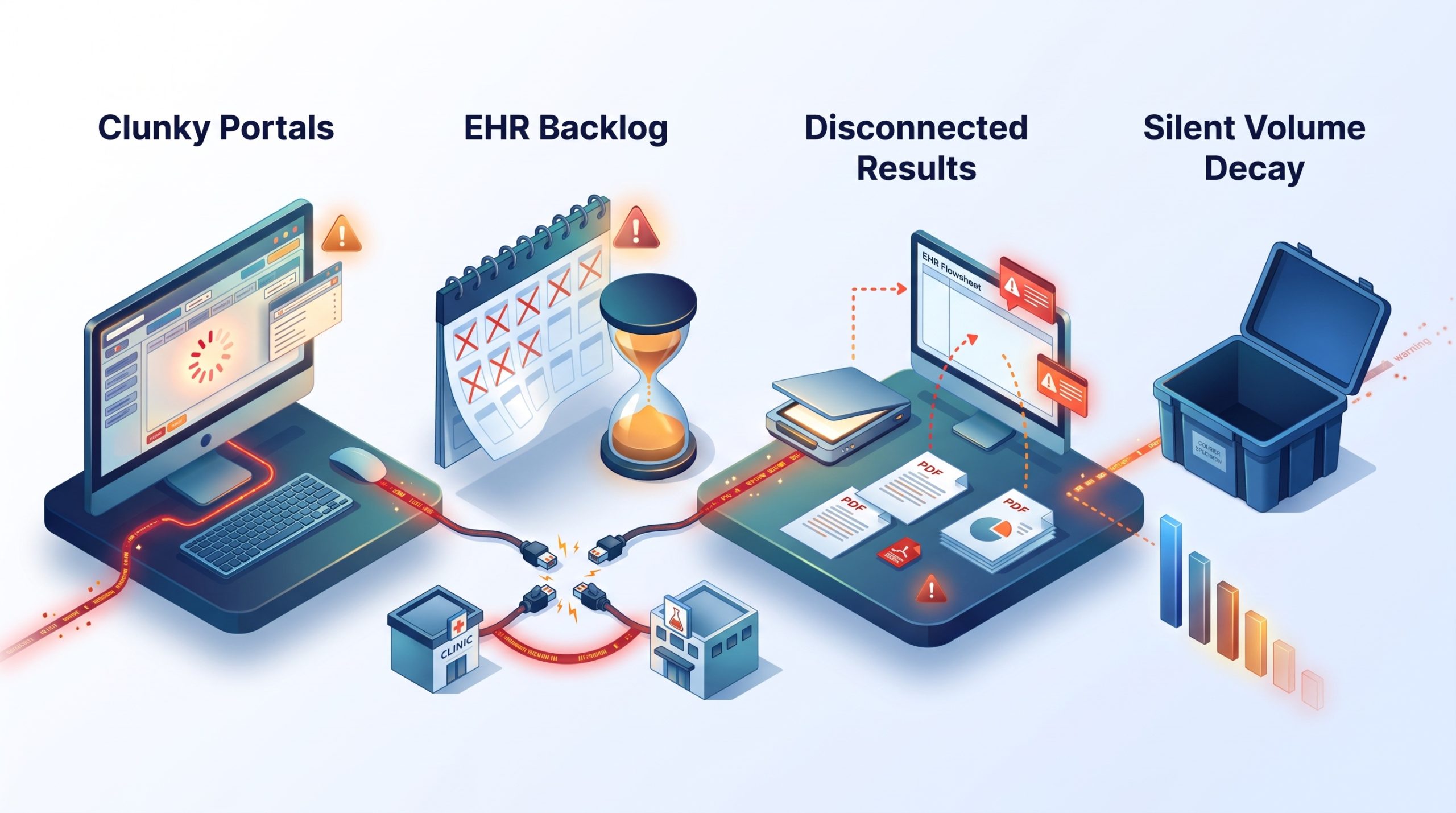
- Clunky, Multi-Click Portal Interfaces: Outdated web portals with unintuitive test lookups, slow page rendering, and missing search filters turn simple order placement into a multi-minute administrative chore.
- The “Endless Implementation” Backlog: When a medical practice asks to link its native Electronic Health Record (EHR) to the laboratory, quoting a 6-to-12-month waitlist pushes the practice directly toward national commercial reference labs that connect in weeks.
- Disconnected Result Delivery: If doctors must manually log into an external website, download detached PDF files, and scan or re-key results into their EHR flowsheet, clinical dissatisfaction quickly turns into account churn.
- Silent Volume Decay: Physician accounts rarely call to cancel their service contract. Instead, they gradually stop placing orders, sending specialized panels away first, then routine chemistry, until the courier tote is consistently empty. By the time quarterly billing reports flag the drop, the account is gone.
Stopping client churn requires addressing the everyday digital friction that drives medical practices away.
How Poor Connectivity Drives Physician Accounts Away
Examining the daily friction points between an outreach laboratory and an ambulatory clinic highlights why accounts defect:
The Anatomy of Client Churn in Outreach
| Daily Digital Friction | Operational Consequence |
|---|---|
| Clunky Portals & Separate Logins | Staff bypass portal for paper/rival |
| Slow EHR Interface Deployment | Account onboarded by mega-lab |
| Missing Upfront Insurance Checks | Denied claims & angry patient bills |
| Delayed Panic Value Delivery | Doctor frustrated by phone tag |
| Zero Volume Visibility | Account defects without warning |
- Portal Fatigue: Forcing clinic staff to remember complex secondary credentials and navigate counterintuitive screens encourages shortcuts, manual paper requisitions, or competitor defection.
- Pre-Analytical Accessioning Errors: Portals that fail to validate patient demographics or insurance coverage upfront allow errors to pass through to the laboratory, leading to specimen redraws, turnaround time (TAT) delays, and patient billing complaints.
- Delayed Critical Alerts: Relying solely on physical fax machines or phone calls to communicate abnormal panic values interrupts clinical workflows and compromises patient safety.
- Lack of Early Detection: Operating without real-time business intelligence leaves laboratory management blind to declining ordering trends until weeks after the revenue has disappeared.
The Retention Framework: 4 Strategic Pillars to Eliminate Outreach Friction
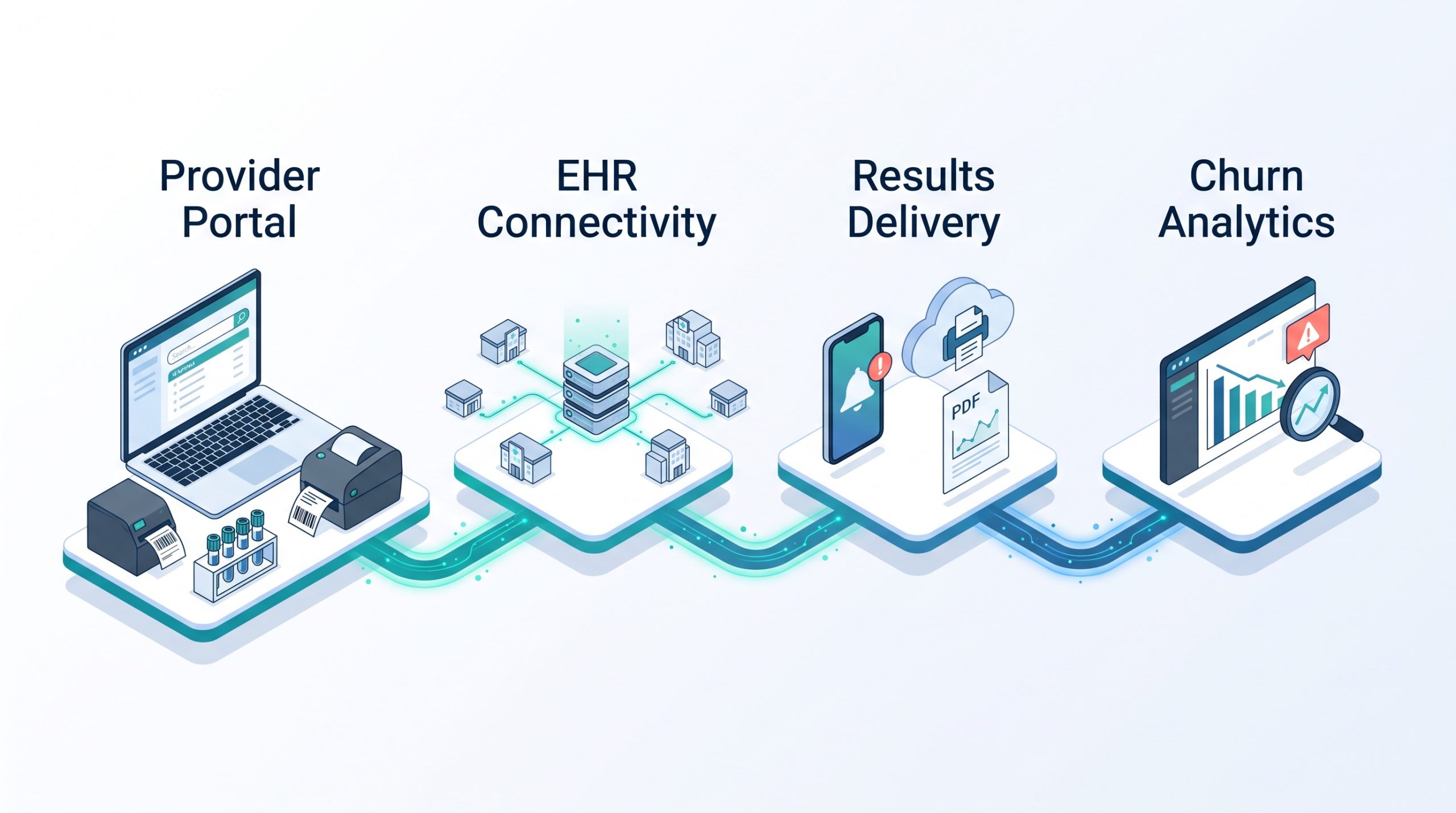
Plugging client attrition requires a cohesive outreach ecosystem that bridges web-based ordering, direct EHR interoperability, mobile clinician engagement, and predictive data analytics.
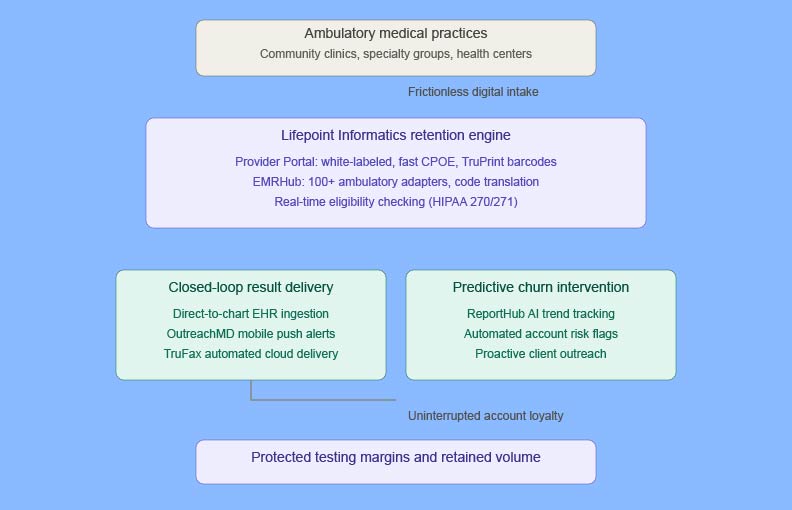
How Lifepoint Informatics Solves Connectivity Friction and Prevents Churn
Founded in 1999, Lifepoint Informatics has spent more than 25 years engineering specialized healthcare integration middleware. Lifepoint Informatics provides outreach laboratories with the software infrastructure needed to retain provider loyalty, eliminate workflow barriers, and protect regional market share.
1. Modernize the Digital Front Door: The Lifepoint Informatics Provider Portal
The Lifepoint Informatics Provider Portal delivers a streamlined, browser-based command center that clinic staff enjoys using:
- Intuitive Computerized Physician Order Entry (CPOE): Predictive search algorithms allow medical assistants to locate complex panels, reflex protocols, and specialized tests in seconds.
- Hospital Laboratory Branding: Customize the portal with your laboratory’s logo and color palette to reinforce brand identity and local clinical trust across every interaction.
- Real-Time Insurance Eligibility Checking: Uses our Insurance Eligibility Checking Module to execute automated HIPAA 270/271 checks across more than 700 commercial, Medicare, and Medicaid payers during order entry. Catching inactive coverage and missing subscriber IDs upfront prevents patient billing disputes that erode account relationships.
- TruPrint Point-of-Collection Barcoding: Generates standardized, instrument-ready barcode labels right at the draw chair via TruPrint, eliminating handwritten tube labels and sample misidentification.
- Recurring & Standing Orders: Simplifies chronic disease management and therapeutic drug monitoring with interactive draw calendars and automated alerts via our Standing Orders Module.
2. Fast-Track EHR Connectivity with Lifepoint Informatics EMRHub
When high-volume practices demand a direct electronic interface, the Lifepoint Informatics EMRHub delivers rapid connectivity without overburdening internal IT teams:
- Pre-Built Adapters for 100+ Ambulatory EHRs: Connects to all major EHR platforms, including Epic Systems, Oracle Health / Cerner, Athenahealth, eClinicalWorks, and NextGen Healthcare, shortening deployment schedules from months to weeks.
- Order Normalization & Compendium Translation: Automatically maps client order codes, LOINC identifiers, and ICD-10 clinical diagnosis codes to match your internal LIS dictionary, eliminating accessioning errors and unmapped test exceptions.
- Fully Managed Integration Engineering: Lifepoint Informatics specialists coordinate directly with external clinic EHR vendors to configure, test, and validate feeds, eliminating internal hospital IT backlogs.
3. Meet Clinicians Where They Work: Multi-Channel Results Dispatch
Clinicians review laboratory findings across diverse environments throughout the workday. Lifepoint Informatics ensures reports arrive where doctors need them:
- Discrete Flowsheet Injection: Automatically files discrete test values, abnormal flags, and cumulative panels directly into ordering EHR flowsheets for longitudinal graphing.
- OutreachMD Mobile App: Dispatches real-time smartphone push alerts for critical lab values, panic thresholds, and STAT orders directly to physicians via the OutreachMD Mobile App, eliminating phone tag.
- TruFax Automated Cloud Faxing: Automatically transmits high-resolution, HIPAA-compliant PDF result reports to backup clinical destinations with automated retry and failover routing via the TruFax Engine.
- AI PDF Report Generation: Automatically synthesizes complex numerical panels into clear, narrative clinical interpretations and longitudinal trend graphs embedded directly within the official PDF report via our AI PDF Report Module.
4. Intervene Before Defection: Predictive Churn Tracking with ReportHub AI
Traditional billing summaries reveal lost accounts months after testing volume drops. The Lifepoint ReportHub AI Module continuously tracks diagnostic data streams in real time:
- Predictive Churn Detection: Machine learning algorithms evaluate ordering frequency across all client accounts. If a medical practice begins ordering fewer panels or ceases ordering specific tests, the system generates an automated churn alert.
- Proactive Account Intervention: Outreach sales teams and account managers receive notifications early enough to visit the practice, identify service bottlenecks, and resolve grievances before the account signs with a competitor.
- Turnaround Time (TAT) Analytics: Tracks specimen lifecycles from clinic collection and courier handoff through accessioning and report sign-off, pinpointing logistical delays before clients complain.
- Conversational Natural Language Queries: Non-technical sales managers can ask conversational questions (e.g., “Show me all family practices with declining metabolic panel volumes over the past 30 days”) to generate instant, exportable retention reports.
Direct Comparison: Churn Vulnerability vs. Lifepoint Informatics Retention
| Outreach Factor | Vulnerable Outreach Operation | Commercial Mega-Lab Strategy | Lifepoint Informatics Retention Engine |
|---|---|---|---|
| Provider Portal Experience | Slow, generic LIS module or paper | Proprietary portal (vendor-locked) | Fast, intuitive, white-labeled with your branding |
| EHR Interface Speed | 6 to 12 months internal IT backlog | 4 to 8 weeks | Days to weeks via pre-built EMRHub adapters |
| Specimen Labeling at Clinic | Handwritten labels (high redraw rate) | Proprietary thermal printers | Instrument-ready TruPrint thermal barcodes |
| Insurance Verification | Discovered post-testing by billing | Automated batch checks | Real-time 270/271 checks across 700+ payers |
| Mobile Provider Access | None (manual phone tag) | Basic mobile app | Native OutreachMD app with critical push alerts |
| Handling Non-Standard EHRs | Breaks on custom hospital dialects | Inflexible standard requirements | 25+ years of proprietary code handling edge cases |
| Account Churn Visibility | Discovered months later in billing | Enterprise CRM tracking | ReportHub AI predictive churn detection alerts |
Enterprise Security, Regulatory Compliance, and Governance
Securing client connectivity and preserving clinical data integrity requires strict adherence to federal standards established by the U.S. Department of Health & Human Services (HHS) and NIST Cybersecurity Guidelines:
- End-to-End Cryptographic Security: Encrypts all electronic orders, mobile push notifications, and laboratory results in transit and at rest using AES-256 and TLS 1.3 standards.
- Audit-Ready Traceability: Generates unalterable, time-stamped logs of every order transmission, demographic correction, result view, and delivery receipt. Ensures complete compliance readiness for College of American Pathologists (CAP), Clinical Laboratory Improvement Amendments (CLIA), and HIPAA audits.
- Role-Based Access Controls (RBAC): Restricts access to sensitive Protected Health Information (PHI) based on credentialed user roles across hospital staff, client physicians, and practice administrators.
- Data Redundancy & High Availability: Cloud-native architecture ensures zero transaction loss during peak accessioning periods or localized hospital network maintenance.
Frequently Asked Questions
1. What causes client churn in laboratory outreach programs?
Client churn in lab outreach is driven primarily by workflow friction, not pricing. Clunky multi-click portals, separate logins, EHR interfaces that take 6 to 12 months to build, and results that don’t file cleanly into patient charts push busy ambulatory practices toward whichever diagnostic provider makes their day easier. Most accounts don’t formally cancel; they gradually redirect specimen volume until the courier tote is empty.
2. How can a lab detect that a physician account is at risk of leaving?
Labs need real-time visibility into ordering trends rather than relying on quarterly billing reports. The Lifepoint ReportHub AI Module uses machine learning to evaluate ordering frequency across all client accounts and generates an automated churn alert when a practice begins ordering fewer panels or stops ordering specific tests. This gives outreach sales teams time to visit the practice and resolve issues before the account signs with a competitor.
3. How long does it take to connect a clinic’s EHR to the lab with Lifepoint EMRHub?
With pre-built adapters for 100+ ambulatory EHRs, including Epic Systems, Oracle Health / Cerner, Athenahealth, eClinicalWorks, and NextGen Healthcare, Lifepoint Informatics EMRHub shortens interface deployment from months to days or weeks. Lifepoint specialists coordinate directly with the clinic’s EHR vendor to configure, test, and validate feeds, so the work doesn’t add to internal hospital IT backlogs.
4. Can the Lifepoint Informatics Provider Portal carry our laboratory’s branding?
Yes. The Lifepoint Informatics Provider Portal is fully white-labeled, so you can customize it with your laboratory’s logo and color palette. This reinforces your brand identity and local clinical trust across every interaction, unlike commercial mega-lab portals that keep clinics tied to the vendor’s own brand.
5. How does Lifepoint Informatics support HIPAA, CLIA, and CAP compliance?
Lifepoint Informatics encrypts all orders, mobile push notifications, and results using AES-256 at rest and TLS 1.3 in transit, and restricts access to PHI through role-based access controls. Every order transmission, demographic correction, result view, and delivery receipt is captured in an immutable, time-stamped audit log, keeping laboratories ready for CAP, CLIA, and HIPAA audits, including unannounced inspections.
Operational Compliance Standard
Managing diagnostic laboratory data exchange across ambulatory networks requires strict alignment with federal mandates governing patient privacy, electronic data interchange (EDI), and diagnostic data integrity. The Lifepoint Informatics Operational Compliance Standard guarantees that all bi-directional order feeds, portal transactions, and result transmissions strictly adhere to:
- CLIA & CAP Analytical Traceability: Replaces fragmented paper records and unlinked interface streams with an immutable, time-stamped digital audit log capturing user IDs, electronic physician signatures, demographic corrections, and result delivery receipts to satisfy all unannounced laboratory inspection criteria.
- HIPAA & HITECH Security Alignment: Protects electronic Protected Health Information (ePHI) across every order entry screen, cloud fax transmission, and mobile interface using AES-256 encryption at rest and TLS 1.3 in transit, backed by granular role-based access controls.
- CMS Clean-Claim & Billing Verification: Enforces pre-accessioning 270/271 real-time eligibility inquiries, mandatory ICD-10 diagnosis cross-referencing, and automated ABN generation to eliminate billing denials and ensure Medicare compliance.
- 21st Century Cures Act Interoperability Mandates: Guarantees seamless, non-blocking digital clinical communication between ambulatory care providers and hospital laboratory testing facilities without proprietary data hoarding.
Deploying the Lifepoint Informatics Outreach Ecosystem removes digital friction, shortens interface deployment schedules, and alerts account managers to ordering shifts before defection occurs, protecting testing margins and cementing long-term physician relationships across your healthcare community. To learn how Lifepoint Informatics can help your laboratory reduce client churn, contact Lifepoint Informatics today to schedule a custom platform demonstration.